
Can You Get a Bail Bond Without a Cosigner in Raleigh, NC?
Sometimes. Not every bail bond is handled the same way, and a separate cosigner or indemnitor is not automatically required in every situation.
If someone has been arrested and a secured bond has been set, you may be ready to call a bail bondsman—only to realize that you do not have a family member or friend available to cosign.
Whether a separate cosigner or indemnitor is required can depend on the bond amount, the defendant’s circumstances, the financial risk involved, available collateral, payment arrangements, and the bail bond agency’s approval requirements.
North Carolina law recognizes professional bail bondsmen as sureties on eligible bail bonds. The statutes also allow a bondsman to accept reasonable collateral or other indemnity from the defendant or someone acting on the defendant’s behalf. They do not establish a rule that every professional surety bond must always include a separate third-party cosigner.
That means the practical answer is:
Do not assume you cannot get help simply because you do not have a cosigner. Call the bail bond agency, explain the situation, and find out what is actually required for that bond.
DJ’s Bail Bonds provides Raleigh bail bond assistance and can review the circumstances of an eligible surety bond to explain what documentation, payment arrangements, collateral, or cosigner requirements may apply.
If you already know the defendant’s full name, date of birth, detention location, bond amount, and bond type, call 919-986-1547 or contact DJ’s Bail Bonds.
Does Every Bail Bond in North Carolina Require a Cosigner?
No. No blanket North Carolina rule says every professional bail bond must include a separate family member or friend as a cosigner.
A professional bail bondsman can act as the surety on an eligible bail bond. North Carolina law defines a professional bondsman as a licensed person who provides security for bail bonds and receives compensation for writing them.
The bail agency may still require another person to sign an indemnity agreement before accepting the financial risk associated with a particular bond.
That is an important distinction.
The court determines the defendant’s release conditions. The bail bond agency determines whether it is willing and able to write the eligible surety bond and what financial protections it requires.
A judicial official does not normally decide whether DJ’s requires an additional cosigner for its own bond agreement.
Why Do Bail Bondsmen Ask for a Cosigner?
A cosigner can reduce the financial risk the bondsman assumes when writing the bond.
When a professional bail bondsman becomes the surety, the bondsman takes on potential financial liability connected with the defendant’s obligation to appear as required.
A cosigner or indemnitor may provide an additional person who:
- Signs the bail-bond agreement
- Accepts specified financial responsibilities
- Helps maintain contact with the defendant
- May provide collateral when required
- Understands the defendant’s court obligations
- Agrees to comply with the terms of the contract
The presence of a reliable cosigner can make some bonds easier for an agency to approve.
That does not mean every bond automatically requires one.
When Might a Bail Bond Be Approved Without a Cosigner?
Whether a no-cosigner bail bond can be considered depends on the individual situation and the bail agency’s approval requirements.
Factors that may matter can include:
- Bond amount
- Defendant’s financial circumstances
- Residence and stability
- Employment
- Court-appearance history
- Nature of the bond
- Available collateral
- Ability to satisfy premium requirements
- Other underwriting considerations
None of these factors guarantees approval.
A person should not assume that having a smaller bond, employment, good credit, or collateral automatically eliminates the need for a cosigner.
The agent needs to review the actual bond.
When Is a Cosigner More Likely to Be Required?
A separate cosigner may become more important as the financial risk associated with the bond increases.
Situations that may involve additional approval requirements include:
- Larger bond amounts
- Significant financial exposure
- Limited payment ability
- Previous failures to appear
- Limited local ties
- Need for collateral
- Complex bond arrangements
- Other risk factors identified during the application process
Again, these are factors an agency may consider—not automatic legal rules.
If the bond is substantial, DJ’s also provides large bail bond services for qualifying situations.
What Is the Difference Between the Surety and the Cosigner?
These terms are often confused.
Surety
The surety is legally responsible on the bail bond.
North Carolina law recognizes professional bondsmen and qualifying insurance companies as types of sureties.
You can review the North Carolina statutes governing bail bondsmen and sureties.
When a professional bail bondsman writes an eligible surety bond, the bondsman is taking on the bond obligation.
Cosigner or Indemnitor
A cosigner is generally someone who enters into an agreement with the bail bond agency and accepts financial or contractual responsibilities relating to the bond.
The cosigner is not the judicial official who sets bail and does not replace the professional bondsman.
DJ’s has a separate guide explaining North Carolina bail bond cosigner responsibilities for people who are considering signing for a defendant.
Can the Defendant Sign for Their Own Bail Bond?
Potentially, depending on the bond and the bail agency’s approval.
There are situations in which the defendant may be able to enter into the bond agreement without a separate third-party cosigner.
But that does not mean every defendant can simply “self-sign.”
The bail agency still needs to determine whether it can accept the bond based on:
- Financial risk
- Bond amount
- Required premium
- Available security
- Defendant information
- Agreement terms
- Other approval considerations
If additional indemnity is needed, the agency may require another person to become involved.
The most efficient approach is to call and ask what the particular bond requires rather than spending hours trying to find a cosigner before speaking with an agent.
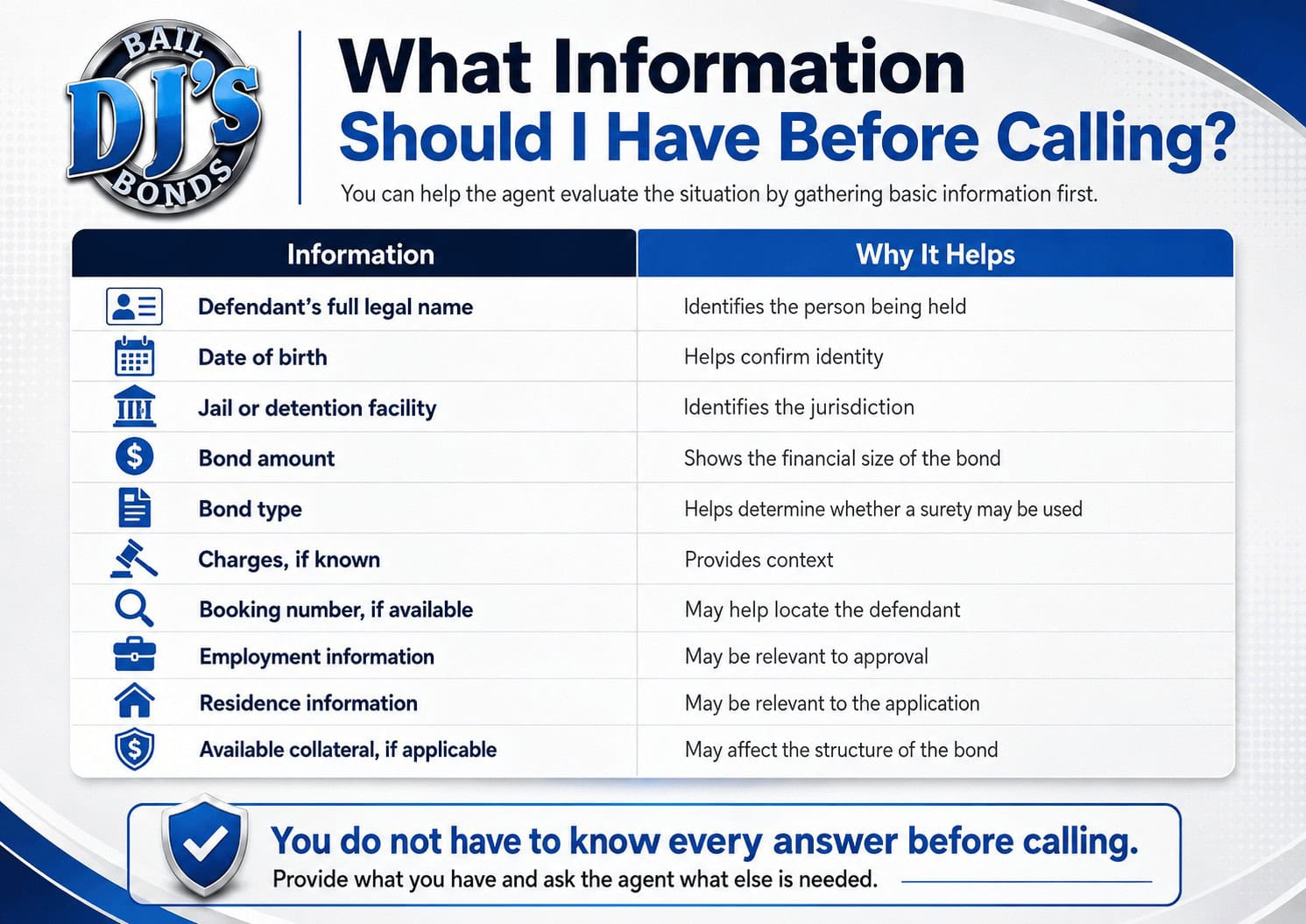
What Information Should I Have Before Calling?
You can help the agent evaluate the situation by gathering basic information first.
| Information | Why It Helps |
|---|---|
| Defendant’s full legal name | Identifies the person being held |
| Date of birth | Helps confirm identity |
| Jail or detention facility | Identifies the jurisdiction |
| Bond amount | Shows the financial size of the bond |
| Bond type | Helps determine whether a surety may be used |
| Charges, if known | Provides context |
| Booking number, if available | May help locate the defendant |
| Employment information | May be relevant to approval |
| Residence information | May be relevant to the application |
| Available collateral, if applicable | May affect the structure of the bond |
You do not have to know every answer before calling.
Provide what you have and ask the agent what else is needed.
Can Collateral Replace the Need for a Cosigner?
Sometimes collateral may affect the way a bail bond is structured, but it should not be assumed that collateral automatically replaces a cosigner.
North Carolina law allows professional bail bondsmen to accept reasonable collateral security or other indemnity from a defendant or someone acting on the defendant’s behalf.
You can review the North Carolina premium, collateral and indemnity rules.
The actual decision depends on the agency and the bond.
If collateral is being considered, ask:
- What type of collateral is acceptable?
- What value is required?
- Who must own it?
- How will it be documented?
- Will a receipt be provided?
- When can the collateral be returned?
- What happens if the defendant misses court?
- Is a cosigner still required?
Collateral can represent significant property or financial value.
Do not provide it without understanding the written agreement.
What Types of Collateral Might Be Discussed?
The acceptable form of collateral depends on the bond and agency requirements.
North Carolina law permits reasonable collateral or other indemnity in connection with a bail bond, subject to statutory requirements.
Depending on the circumstances, a bail agent may discuss assets such as property or other items with documentable value.
However, never assume an asset will automatically be accepted.
The bondsman must determine whether the proposed security is appropriate for the amount and risk of the bond.
Do I Still Have to Pay a Premium Without a Cosigner?
Yes. Not needing a separate cosigner does not mean the bail-bond service is free.
North Carolina law defines the premium as the amount paid in exchange for a bail bondsman’s services in writing the bond. The state also regulates the maximum premium that may be accepted.
A no-cosigner arrangement affects who signs and guarantees obligations under the agency agreement.
It does not eliminate the premium.
Before moving forward, ask the agent to explain:
- Total premium
- Amount due initially
- Any deferred balance
- Payment schedule if applicable
- Collateral requirements
- Other financial responsibilities
Can I Use a Payment Plan If I Do Not Have a Cosigner?
Payment options and cosigner requirements are separate approval questions.
DJ’s currently provides online forms for payment arrangements, defendant applications, and cosigner applications.
A person might qualify for one type of arrangement but not another.
For example:
- A payment plan does not automatically eliminate a cosigner requirement.
- Having a cosigner does not automatically guarantee a payment plan.
- Providing collateral does not necessarily eliminate the premium.
- Paying the premium upfront does not automatically guarantee approval without another signer.
The entire bond has to be evaluated together.
You can review the DJ’s Bail Bonds online forms and speak with an agent about the specific situation.
What If I Cannot Find Anyone Willing to Cosign?
Call the bail bond agency anyway.
One of the biggest mistakes a family can make is assuming the process has stopped before asking what alternatives may be available.
Tell the agent directly:
“I do not have anyone available to cosign. Is there another way this bond can be approved?”
The answer may be yes or no depending on the bond.
The agent may discuss:
- Whether a separate cosigner is actually required
- Whether the defendant can qualify under the agency’s requirements
- Whether collateral affects the decision
- What payment terms apply
- Whether another qualified indemnitor may be used
- Whether the agency can write the bond at all
If DJ’s cannot approve the bond without a cosigner, knowing that immediately allows the family to focus on finding an appropriate signer rather than losing time making assumptions.
Does the Cosigner Have to Be a Family Member?
Not necessarily.
A cosigner is commonly a relative because relatives are often the people willing to assume responsibility for someone they trust.
But the key question is whether the proposed signer satisfies the bail agency’s requirements.
Depending on the situation, another responsible adult may potentially be considered.
That could include:
- A friend
- Employer
- Partner
- Other relative
- Another person with an established relationship to the defendant
The bail agency decides whether the proposed cosigner is acceptable under its agreement and approval requirements.
What Does DJ’s Look for in a Cosigner?
The exact requirements can depend on the bond.
DJ’s existing cosigner materials discuss information such as:
- Identity
- Address
- Employment
- Financial information
- Relationship to the defendant
- Possible collateral
- Ability to understand and accept the agreement
The purpose is not simply to collect a signature.
The bondsman needs to determine whether the person entering into the agreement can reasonably satisfy the responsibilities being accepted.
For that reason, a person should never agree to cosign without reading the entire contract.
Can Someone Cosign From Outside Raleigh?
The answer depends on the bail bond agency’s procedures and the particular bond.
If your potential cosigner does not live in Raleigh, tell the agent immediately.
Do not assume that geographic distance automatically disqualifies the person, and do not assume remote signing will always be permitted.
DJ’s provides online defendant and indemnitor application forms, which can help begin gathering the information necessary for review.
The agent can explain what identification, documentation, signatures, or other steps are required for the specific transaction.
Does Having No Cosigner Change the Court’s Bond?
No.
The judicial official determines the defendant’s conditions of pretrial release.
The bail bond agency cannot reduce or change that court-ordered bond simply because the defendant does not have a cosigner.
If the release order permits an eligible surety bond, the agency can determine whether it can provide that surety under acceptable financial and contractual terms.
Questions about changing the court’s release conditions should be discussed with a criminal defense attorney.
Could I Pay the Full Bond Instead of Finding a Cosigner?
Depending on the release conditions, a secured bond may be satisfied through one of the forms of security authorized by North Carolina law.
North Carolina’s bail statutes recognize secured appearance bonds supported by full cash, qualifying property, or a solvent surety in applicable situations.
You can review the North Carolina bail definitions and surety statute.
That means a professional surety bond is not always the only possible route.
However, personally posting the full amount can create very different financial consequences from using a bail bondsman.
Before deciding, make sure you understand:
- The amount required
- The form of security permitted
- How long funds or property may be tied up
- Bail-bond premium requirements
- Collateral requirements
- Cosigner responsibilities
- Risks if the defendant fails to appear
What If the Bond Is Large and I Have No Cosigner?
This situation usually requires a direct conversation with the bail bond agency.
A larger bond creates greater financial exposure for the surety, so additional safeguards may be required.
Depending on the case, the agency may need:
- A qualified cosigner
- Stronger collateral
- Additional financial documentation
- Different payment arrangements
- Additional underwriting review
If you are dealing with a substantial bond amount, contact DJ’s rather than assuming the requirements for a smaller bond will apply.
What If My Potential Cosigner Has Bad Credit?
Do not automatically assume that the person cannot help.
Credit may be one factor an agency considers, but a bail bond decision can involve multiple factors.
Depending on the bond, the agent may consider:
- Income
- Employment
- Residence
- Assets
- Collateral
- Relationship to defendant
- Bond amount
- Defendant’s circumstances
- Other available security
The agency should evaluate the actual application rather than the family trying to predict approval on its own.
What Should I Ask a Bail Bondsman If I Have No Cosigner?
Ask direct questions before spending time searching for someone to sign.
1. Does This Bond Require a Cosigner?
Start with the most important question.
2. Can the Defendant Qualify Without One?
Ask whether the agency considers no-cosigner arrangements for this type of bond.
3. What Information Do You Need?
Have the defendant’s identification and bond information available.
4. Does the Bond Amount Affect the Decision?
Higher-value bonds may involve additional requirements.
5. Would Collateral Be Required?
Ask what type and how it would be documented.
6. What Premium Is Required?
Know the cost before signing.
7. Are Payment Options Available?
Do not assume approval.
8. If I Need a Cosigner, Who Can Qualify?
Ask what standards the proposed signer needs to meet.
9. Can the Forms Be Started Online?
DJ’s provides online application forms for defendants and indemnitors.
10. What Happens After the Bond Is Posted?
Remember that the detention facility—not the bondsman—controls final release processing.
What Happens After a Bail Bond Is Approved?
If DJ’s approves an eligible surety bond, the remaining steps typically involve completing the required agreement, satisfying payment and collateral requirements if applicable, and posting the bond.
The general sequence is:
Release conditions determined → bond information confirmed → bail application reviewed → financial requirements completed → eligible surety bond posted → detention facility processes release
Posting the bond does not guarantee that the defendant immediately leaves the jail.
Release timing is controlled by the detention facility and can vary depending on booking status, workload, other holds, court orders, paperwork, and facility procedures.
Why Should I Use a Licensed North Carolina Bail Bondsman?
Bail bondsmen operating in North Carolina are regulated by the North Carolina Department of Insurance.
Professional bondsmen and surety bondsmen must meet state licensing requirements before performing bail-bond functions.
You can review the North Carolina Department of Insurance bail bondsmen licensing resources when verifying a provider.
Avoid anyone who claims:
- Everyone qualifies without a cosigner
- No documentation is needed
- No premium is required
- The bondsman can lower the court’s bond
- Release can be guaranteed by a certain time
- Collateral never has to be documented
- Court requirements can be bypassed
The legitimate answer to “Can I get a bail bond without a cosigner?” should always depend on the actual bond.
Need a Bail Bond Without a Cosigner in Raleigh?
Not having a cosigner available does not automatically mean you should stop trying to arrange a bond.
The first step is to find out whether the particular bond actually requires one.
DJ’s Bail Bonds can review an eligible surety bond and explain:
- Whether a separate cosigner is required
- What information the defendant needs to provide
- Premium requirements
- Possible payment options
- Whether collateral is required
- What documentation is needed
- What alternatives may be available if the first arrangement cannot be approved
For Raleigh bail bonds and Wake County bond assistance, call 919-986-1547 or contact DJ’s Bail Bonds.
Have the defendant’s full name, date of birth, detention location, bond amount, and bond type available if possible.
This information is general and is not legal advice. Bond conditions and court procedures depend on the individual case and controlling court orders. A criminal defense attorney can provide advice about the criminal case.
Frequently Asked Questions
Can I get a bail bond in Raleigh without a cosigner?
Possibly. A separate cosigner is not automatically required by a blanket North Carolina rule for every professional surety bond. Whether DJ’s can approve a bond without one depends on the bond amount, defendant information, financial risk, payment requirements, collateral, and other approval considerations.
Does a small bail bond need a cosigner?
Not necessarily. Some lower-risk bonds may be considered without a separate cosigner, but the amount alone does not determine approval. The bail bond agency still evaluates the defendant, financial arrangement, and overall risk before deciding what is required.
Can the defendant cosign for themselves?
A defendant may potentially be able to enter into the bail-bond agreement without a separate third-party cosigner in some situations. That is not guaranteed. The agency must determine whether the bond can be approved based on its financial and underwriting requirements.
Can collateral replace a cosigner?
Collateral may affect how a bail bond is approved, but it should not be assumed that collateral automatically replaces a cosigner. North Carolina law permits reasonable collateral and indemnity, while the agency determines what security is required for the particular bond.
Does the cosigner have to be related to the defendant?
Not necessarily. A proposed cosigner may be a relative, friend, partner, employer, or another responsible adult, depending on the agency’s requirements. The bondsman evaluates whether the person is acceptable for the particular agreement.
What if I cannot find anyone willing to cosign?
Call the bail bond agency before giving up. Ask whether the bond can be considered without a cosigner, whether collateral or another arrangement affects approval, and what requirements would apply. If a cosigner is mandatory for that bond, the agent can explain what qualifications the signer needs.
Can I use a payment plan without a cosigner?
Possibly, but payment-plan approval and cosigner requirements are separate decisions. A payment plan does not automatically remove a cosigner requirement. Ask the agent to review the complete bond and explain the available arrangement before signing.
Do large bail bonds usually require a cosigner?
Higher-value bonds commonly involve additional financial safeguards. The exact requirements depend on the individual bond and approval process, so families should ask the bail agent what is required rather than assuming the same terms apply to every bond.
Sources
- North Carolina General Assembly — G.S. 15A-531: Bail Definitions and Sureties
- North Carolina General Assembly — Chapter 58, Article 71: Bail Bondsmen and Runners
- North Carolina General Assembly — G.S. 58-71-95: Premium, Collateral and Indemnity Rules
- North Carolina Department of Insurance — Bail Bondsmen Licensing