
Introduction: What Is the Difference Between Bail and Bond North Carolina?
When someone is arrested, family members hear confusing terms: “bail,” “bond,” “own recognizance,” “surety,” “secured,” “unsecured.” Many people use these words interchangeably, but they mean very different things. Understanding the difference between bail and bond north Carolina can save you thousands of dollars and help you make better decisions under pressure.
In simple terms:
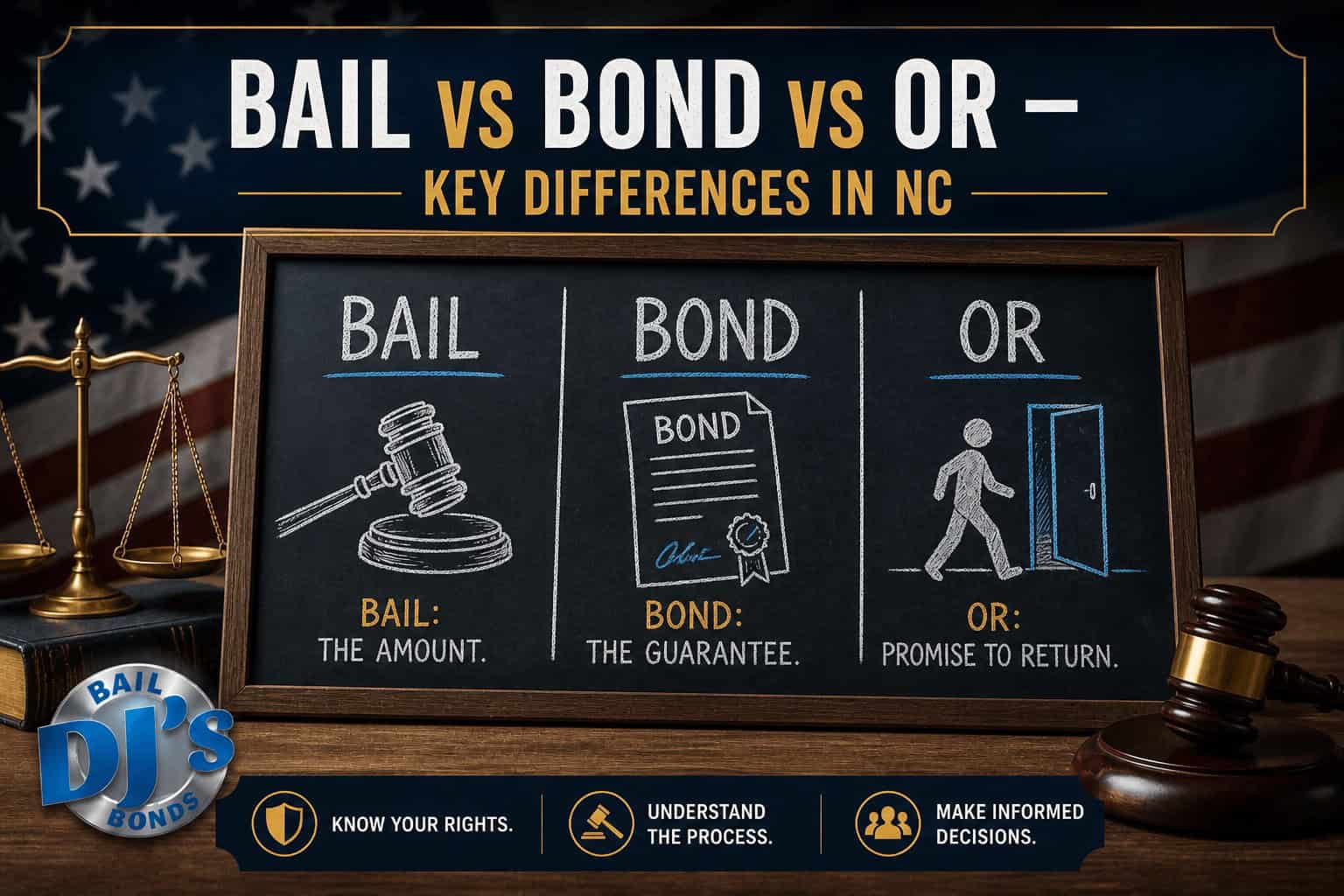
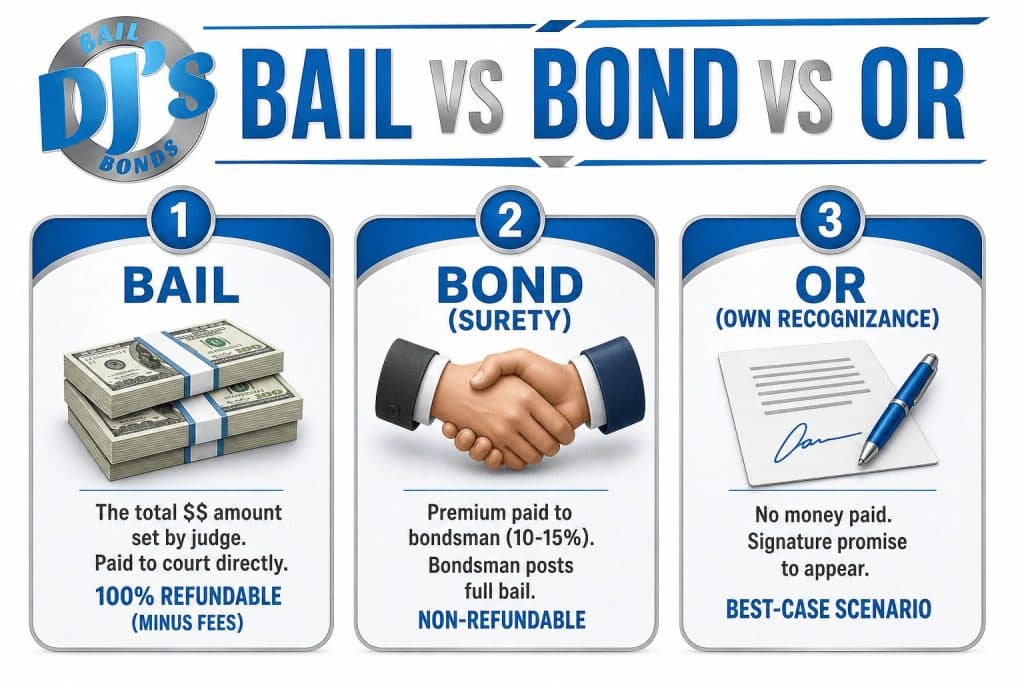
Bail is the dollar amount the court sets for release.
Bond is the legal document (often provided by a bondsman) that guarantees payment of that bail.
Own Recognizance (OR) is release without paying any money, based on a written promise to appear.
This guide explains each option in detail, compares costs and risks, and helps you choose the best path when a loved one is in jail. For immediate help, call DJ’s Bail Bonds at 919-986-1547.
Option 1: Own Recognizance (OR) – The No-Cost Release
Own Recognizance (often called “OR” or “personal recognizance”) is the most favorable release condition in North Carolina. The defendant is released from jail without paying any money. Instead, they sign a written promise to appear for all court dates.
Who Qualifies for OR?
OR is not available to everyone. A magistrate or judge considers:
Non-violent, low-level misdemeanors (e.g., minor traffic offenses, petty theft).
No criminal history or very limited record.
Strong community ties (job, family, long-term residence).
Low flight risk (no passport, no out-of-state family).
Advantages of OR
Zero upfront cost – No premium, no bail payment.
No cosigner needed – The defendant alone signs the promise.
No collateral – No risk to family assets.
Disadvantages of OR
Not available for felonies or serious charges – Most defendants in North Carolina do not qualify.
Can be revoked – If the defendant misses court, OR is typically revoked, and a secured bond is required.
North Carolina law on pretrial release conditions, including OR, is found in Chapter 15A of the General Statutes. See Article 26 for release conditions.
Option 2: Bail – The Court-Ordered Amount
Bail is the specific dollar amount the court requires as security for the defendant’s release. It is not a payment – it is a financial guarantee. The defendant can get that money back if they appear for all court dates.
How Cash Bail Works
If the court sets bail at $10,000, the defendant or a family member can pay that full amount in cash directly to the clerk of court.
The court holds the money. If the defendant makes every court appearance, the $10,000 is returned (minus administrative fees, typically 5–10%). If the defendant misses court, the $10,000 is forfeited to the state.
Advantages of Cash Bail
Money is refundable (minus fees) if all court dates are met.
No bondsman fee – You keep the 10-15% premium you would otherwise pay.
Disadvantages of Cash Bail
Large upfront cash requirement – Few families have 10,000,10,000,25,000, or $50,000 in liquid cash.
Money tied up for months or years – Cases can take 6-18 months.
Risk of forfeiture – If the defendant misses even one court date, you lose the entire cash bail.
For current administrative fees for cash bail, check with your county clerk of court. Wake County’s fee schedule is available at the North Carolina Judicial Branch website.
Option 3: Surety Bond – The Most Common Choice
When people ask about the difference between bail and bond north Carolina, this is usually what they mean. A surety bond is a legal document provided by a licensed bail bondsman. The bondsman posts the full bail amount to the court on behalf of the defendant. In exchange, the defendant or a cosigner pays the bondsman a non-refundable premium (10-15% of the bail amount).
How a Surety Bond Works
Bail set at: $25,000
- The family pays DJ’s Bail Bonds a premium of $2,500 (10%).
- DJ’s posts the full $25,000 bond with the court.
- The defendant is released.
If the defendant appears in court, the bond is exonerated, and DJ’s gets the $25,000 back. The family does not get the $25,000 back, and they also do not get the $2,500 premium back (it is the fee for service).
If the defendant misses court, DJ’s must pay the court $25,000 and will then seek repayment from the cosigner.
Advantages of a Surety Bond
Low upfront cost – Only 10-15% of bail, not the full amount.
24/7 availability – Bondsmen work nights, weekends, holidays.
No need for full cash – Most families do not have thousands in liquid cash.
Professional guidance – Bondsmen help track court dates and avoid forfeiture.
Disadvantages of a Surety Bond
Premium is non-refundable – Even if charges are dropped.
Cosigner liability – The cosigner owes the full bond if defendant fails to appear.
Collateral may be required – For high bond amounts.
Quick Comparison Table: Difference Between Bail and Bond North Carolina
| Feature | Own Recognizance (OR) | Cash Bail | Surety Bond |
|---|---|---|---|
| Upfront Cost | $0 | 100% of bail amount | 10-15% (non-refundable) |
| Money Refundable? | N/A | Yes (minus fees) | No |
| Speed | Slow (judge approval) | Fast (if you have cash) | Fastest (24/7) |
| Cosigner Required? | No | No | Usually |
| Collateral Required? | No | No | Sometimes |
| Best For | Minor charges, clean record | Low bail, liquid cash available | High bail, emergency, no cash |
Which Option Is Right for You?
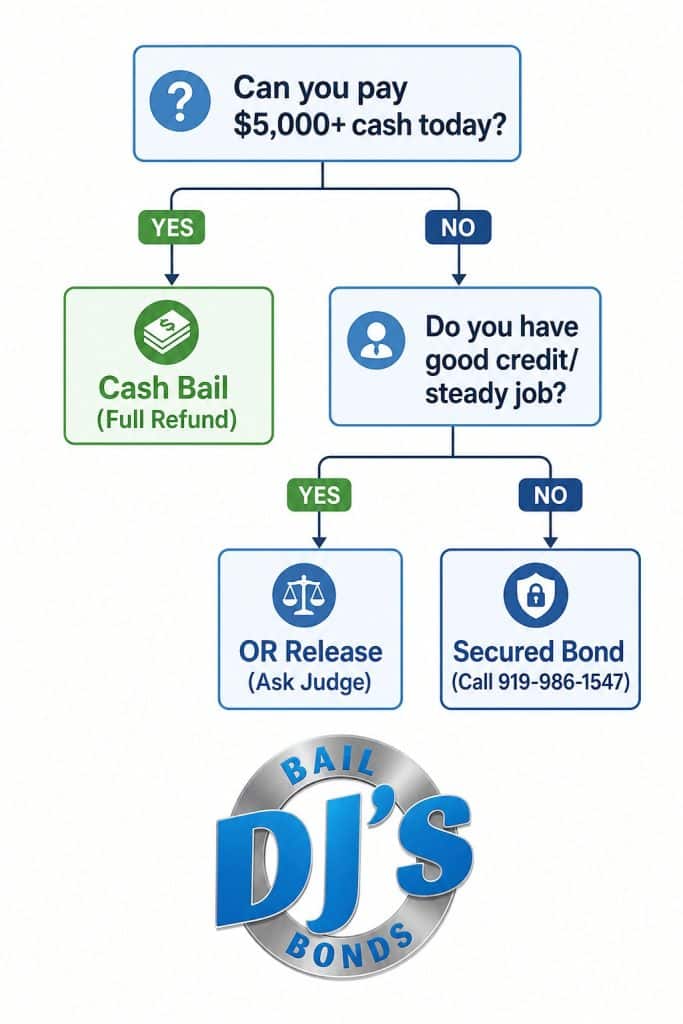
Choose OR if:
The charge is a minor misdemeanor (e.g., simple possession, trespassing).
The defendant has no criminal record.
The defendant has a job, family, and local residence.
You have time to wait for a judge’s OR determination (often requires a bail hearing).
Choose Cash Bail if:
You have the full bail amount in cash.
The bail amount is relatively low (under $5,000).
You are certain the defendant will not miss court.
You want to avoid paying a non-refundable premium.
Choose a Surety Bond if:
You cannot afford the full cash bail.
The bail amount is high ($10,000+).
You need release ASAP (night or weekend).
You want a professional to guide you through the process.
Internal Link: For help deciding, read our guide on How to Choose a Reliable Bail Bondsman in Raleigh, NC and our explanation of How Bail Bonds Work in North Carolina
Why Understanding the Difference Between Bail and Bond North Carolina Matters
Many families make expensive mistakes because they do not understand their options. For example, some pay cash bail when they could have obtained OR. Others pay a bondsman’s premium when they could have afforded cash bail and gotten a full refund later. Worse, some fall for scams because they do not know how legitimate bonds work.
By understanding the difference between bail and bond north Carolina, you can:
Save money by choosing the right option.
Avoid scams by recognizing illegitimate demands.
Protect your cosigner from unnecessary risk.
Get your loved one released faster.
Why DJ’s Bail Bonds Is Your Trusted Guide
At DJ’s Bail Bonds, we do not just post bonds – we educate families. When you call us at 919-986-1547, we will:
Explain all three release options (OR, cash bail, surety bond).
Help you determine which is best for your situation.
If a surety bond is right, we offer 10-15% premiums, flexible payment plans, and 24/7 service.
We have served North Carolina since 2011. Thousands of families trust us because we are transparent, compassionate, and effective.
Do not navigate the legal system alone. Whether you need an OR hearing, cash bail advice, or a surety bond posted tonight, DJ’s Bail Bonds is here. Call 919-986-1547 now for a free consultation. Visit our contact page or call 24/7. We answer every call.
FAQ: Difference Between Bail and Bond North Carolina
What is the main difference between bail and bond north Carolina?
Bail is the dollar amount set by the court. A bond is the legal document (often provided by a bondsman) that guarantees payment of that bail. Bail is the “what”; bond is the “how.”
What is own recognizance (OR) release?
OR release allows a defendant to be freed without paying any money. They sign a written promise to appear in court. It is reserved for low-risk, non-violent offend
Is cash bail refundable in North Carolina?
Yes. If the defendant pays the full cash bail and appears for all court dates, the money is returned (minus administrative fees, typically 5-10%).
Is a surety bond premium refundable?
No. The premium paid to a bail bondsman (10-15% of bail) is a non-refundable service fee for posting the bond and assuming financial risk.
Which option is fastest for getting someone out of jail?
A surety bond through a 24/7 bondsman like DJ’s is typically fastest. We can post bond within minutes of the bail being set, even at 3 AM.
Who qualifies for own recognizance in North Carolina?
OR is typically granted for minor misdemeanors, first-time offenders, defendants with jobs and family in the area, and low flight risk. Felonies rarely qualify.
Can I choose between cash bail and a surety bond?
Yes. If the court sets a secured bond, you can either pay the full cash amount to the court or hire a bondsman to post a surety bond for a premium.
What happens if I pay cash bail and the defendant misses court?
The full cash bail is forfeited to the state. You lose the entire amount, with no refund.
Which option is best if I have no savings?
A surety bond through a bondsman is your best option. You pay only 10-15% upfront. Some bondsmen (including DJ’s) offer payment plans.
How do I know which release condition the judge set?
The magistrate or judge will specify the type of bond on the release order. Common terms: “Secured Bond,” “Unsecured Bond,” “Cash Bond,” or “OR.” A bondsman can explain any term you do not understand.