
Introduction: What Really Happens When You Miss Court Date North Carolina
You had every intention of showing up. But you forgot. Or your car broke down. Or you were scared. Whatever the reason, you missed your court date. Now you are asking: What happens when you miss court date north Carolina? The answer is serious – and it affects not just you, but also your cosigner, your family, and your freedom.
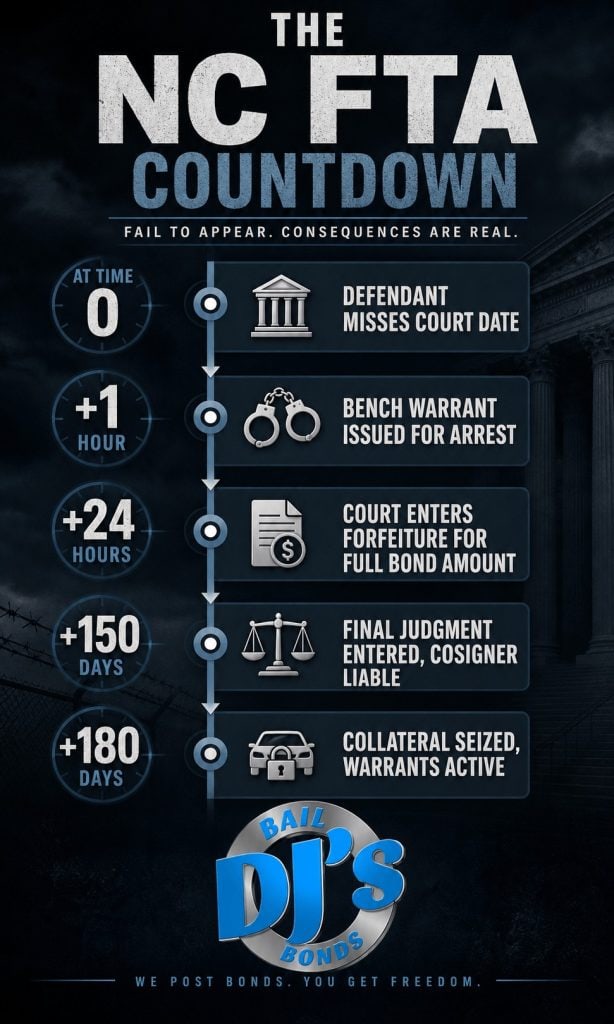
When a defendant fails to appear (FTA) in North Carolina, the judge issues a bench warrant for arrest and the court enters a bond forfeiture. This triggers a 150-day countdown that can end with the cosigner losing their home, car, or savings. Understanding the process is critical to protecting everyone involved. This guide explains exactly what happens when you miss court date north Carolina, how to fix it, and how DJ’s Bail Bonds (call 919-986-1547) can help you get back on track.
Immediate Consequences: Bench Warrant and Bond Forfeiture
The moment you miss court date north Carolina, two things happen automatically under North Carolina law (N.C. Gen. Stat. § 15A-544.3).
1. Bench Warrant Issued
The judge signs a bench warrant for your immediate arrest. This warrant is entered into law enforcement databases statewide. If you are pulled over for a broken taillight, the officer will see the warrant and arrest you on the spot. You can be taken to jail at any time – day or night.
2. Bond Forfeiture Entered
The court also enters a bond forfeiture. This means the full amount of your bail bond is now owed to the court. The bondsman is notified, and the bondsman will notify the cosigner. At this point, the cosigner becomes potentially liable for the full bond amount – not just the premium they already paid.
Read the exact language of the forfeiture statute at the North Carolina General Assembly website (search for §15A-544.3).
The 150-Day Grace Period: Your Window to Fix the FTA
North Carolina law provides a critical 150-day grace period to set aside the forfeiture. Under N.C. Gen. Stat. § 15A-544.4, the bondsman and cosigner have 150 days from the date the clerk mails the forfeiture notice to locate the defendant and bring them back to court.
How to Set Aside a Forfeiture
If the defendant is returned to court within 150 days – either voluntarily or through a recovery agent – the judge may set aside the forfeiture. This means:
The bond is reinstated (or exonerated if the case is resolved).
The cosigner is not liable for the full bond amount.
However, the cosigner may still owe court costs (typically 100−100−500) and the bondsman’s location expenses.
What Happens After 150 Days?
If the defendant is not found within 150 days, the court enters a final judgment of forfeiture. The bondsman must pay the court the full bond amount. Then the bondsman will pursue the cosigner for that same amount – plus interest and collection costs. This can lead to:
Seizure of collateral (car, house, jewelry).
Lawsuit and wage garnishment.
Destruction of credit score.
How a Bench Warrant Affects Your Daily Life
When you miss court date north Carolina, the bench warrant does not just sit quietly. It actively affects:
Driving: Any traffic stop leads to arrest.
Employment: Some employers run periodic background checks. A warrant can cost you your job.
Travel: You cannot fly (TSA checks for warrants) or travel internationally. Renewing a passport may be denied.
Housing: Landlords and property managers often screen for active warrants.
Banking: Some banks freeze accounts if a warrant appears on a background check (rare but possible).
The only way to remove the warrant is to appear before a judge, explain why you missed court, and ask the judge to recall the warrant.
What the Cosigner Should Do Immediately After an FTA
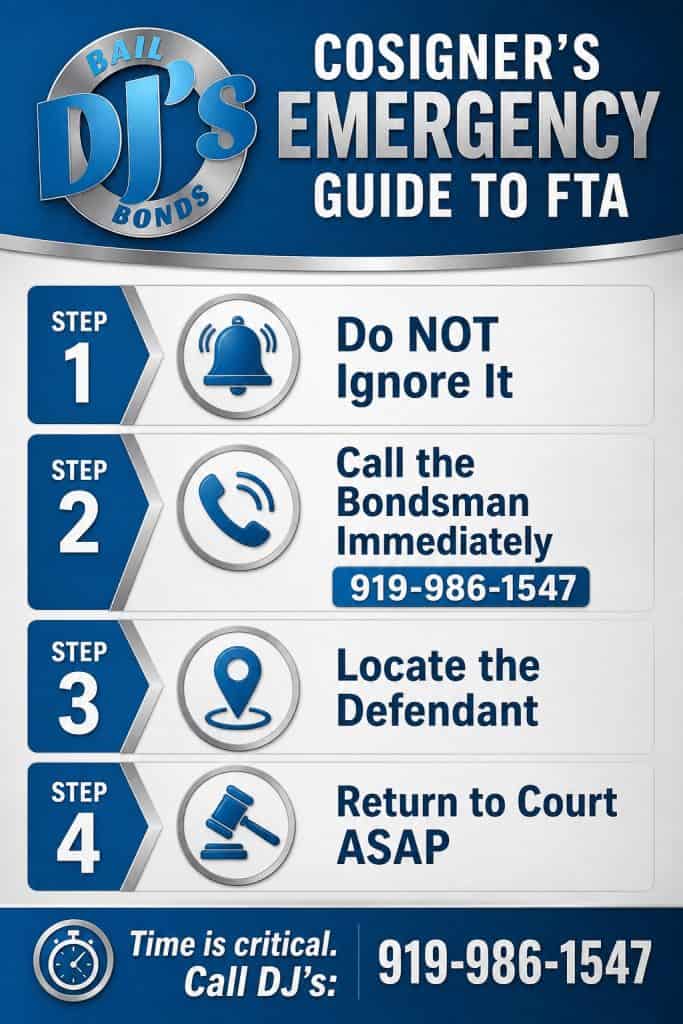
If you are the cosigner and you learn the defendant has missed court, do not panic. Follow these steps:
Step 1: Contact the Bondsman Immediately
Call DJ’s Bail Bonds at 919-986-1547. We will confirm whether a forfeiture has been entered and provide the exact deadline (150 days from the notice date).
Step 2: Locate the Defendant
Start calling, texting, and visiting known addresses. Ask friends and family. The faster the defendant is found, the better.
Step 3: Get the Defendant to Court Voluntarily
Voluntary surrender looks much better to a judge than being arrested. The defendant should go to the courthouse clerk’s office or appear at the next scheduled hearing.
Step 4: File a Motion to Set Aside Forfeiture
The bondsman or an attorney can file a motion to set aside the forfeiture. If granted, the forfeiture is cancelled, and the cosigner is not liable.
For more details on cosigner responsibilities, read our guide: The Role of a Cosigner in North Carolina Bail Bonds.
Add Your Heading Text HereExcusable vs. Inexcusable Reasons for Missing Court
When you finally appear before a judge, they will ask why you missed court. Some reasons may lead to the judge recalling the warrant and setting aside the forfeiture. Others will not.
Excusable Reasons (May Lead to Dismissal of FTA)
Medical emergency (with hospital records)
Car accident (police report)
Death in immediate family (obituary)
Court clerk error (wrong date on notice)
Incarceration in another jurisdiction
Inexcusable Reasons (Warrant and Forfeiture Stand)
“I forgot”
“I overslept”
“My car broke down but I didn’t call anyone”
“I was scared”
“I didn’t have a ride”
If your reason is excusable, bring documentation. If not, be honest and apologize – the judge may still show leniency, especially for a first offense.
Can You Be Held Without Bail After an FTA?
Yes. After you miss court date north Carolina, the judge may order that you be held without bail – meaning you stay in jail until your trial. This is called pretrial detention. Judges use this for defendants who have a history of FTA or who pose a flight risk. Even if the judge sets a new bail, it will likely be much higher than the original.
How DJ’s Bail Bonds Helps After an FTA
We do not abandon our clients when things go wrong. If you or your loved one misses court, DJ’s Bail Bonds will:
Immediately notify the cosigner of the forfeiture and deadline.
Work with recovery agents (bounty hunters) to locate the defendant, if necessary.
Assist the cosigner in filing a motion to set aside forfeiture.
Negotiate with the court for reduced costs.
Our goal is to protect the cosigner while getting the defendant back into compliance. Call us as soon as you realize a court date was missed.
Did you or a loved one miss court date north Carolina? Do not wait. Every day brings you closer to final judgment. Call DJ’s Bail Bonds now at 919-986-1547 for immediate advice. We can explain your options, help locate the defendant, and work to set aside the forfeiture. Visit our contact page or call 24/7.
FAQ: Miss Court Date North Carolina – Failure to Appear
What is the first thing that happens when I miss court date north Carolina?
The judge issues a bench warrant for your arrest and the court enters a bond forfeiture. Law enforcement can arrest you at any time.
What is a bench warrant?
A bench warrant is a court order authorizing law enforcement to arrest you immediately and bring you before the judge to answer for the missed appearance.
What is bond forfeiture?
Bond forfeiture means the full amount of your bail is now owed to the court. The bondsman must pay, and then the bondsman seeks repayment from the cosigner.
How long do I have to fix a missed court date in North Carolina?
Under N.C. Gen. Stat. § 15A-544.4, the bondsman and cosigner have approximately 150 days from the forfeiture notice to locate the defendant and return them to court to set aside the forfeiture.
Can a forfeiture be set aside?
Yes. If the defendant is returned to court within 150 days, the judge can set aside the forfeiture. Court costs and location fees may still apply.
What happens to the cosigner if the defendant is not found within 150 days?
The court enters final judgment. The bondsman pays the full bond amount, then sues the cosigner for that amount, seizes collateral, and may garnish wages.
Will I go to jail immediately after missing court?
Not necessarily immediately, but the bench warrant is active. Any police interaction (traffic stop, ID check) will lead to arrest.
Can I turn myself in after missing court?
Yes. Voluntarily surrendering at the courthouse or jail is much better than being arrested. The judge may look more favorably on a voluntary surrender.
Does missing court affect my original criminal case?
Yes. The judge may revoke your pretrial release, increase bail, or hold you without bail. It also damages your credibility with the court.