

Can You Travel While on Bond in NC? Rules and Permission
A work assignment, family emergency or planned trip can raise an important question after release from jail: can you travel while on bond without putting your release at risk?
The answer depends on the conditions that apply to your particular case. Before leaving, identify what your court order allows, what your bond agreement requires and whether you have supervision obligations. A familiar destination or a short trip can still create a problem if it conflicts with those requirements.
The quick answer
You may be able to travel while on bond in North Carolina, but release does not automatically give you unrestricted permission to travel. Your current release order, any supervision conditions and your bond agreement determine what you need to check.
If a proposed trip conflicts with a court restriction, ask your attorney about requesting a change before departure. A bondsman’s consent cannot override a court order, and a travel reservation does not excuse a required court appearance.
Read the current conditions, including attachments and later changes.
Court conditions, supervision rules and bond terms serve different purposes.
Resolve questions and obtain any required approvals before traveling.
What controls whether you can travel while on bond?
North Carolina law allows a judicial official to impose restrictions on a defendant’s travel, associations, conduct or residence as conditions of pretrial release. The important question is what restrictions were actually imposed in your case. Read G.S. 15A-534 for the statutory framework.
Start with the most recent release order rather than relying on a remembered conversation from the day someone left jail. Look for additional pages, handwritten conditions and subsequent orders. If you have more than one pending case, review the conditions for each case separately.
Pay attention to restrictions that affect the trip indirectly. A curfew, approved residence, monitoring schedule, required appointment or no-contact condition can matter even when the order does not contain a sentence labeled “travel restrictions.”
Three sets of requirements to distinguish
| Requirement | Where to look | What to confirm |
|---|---|---|
| Court conditions | Current release order and later court orders | Geographic limits, court appearances, curfew, residence and other restrictions |
| Supervision conditions | Applicable court directions and supervision instructions | Reporting, monitoring, approved schedules and any delegated approval process |
| Bond agreement | Signed paperwork with the bonding company | Travel notice, consent, communication and address-update requirements, if included |
A practical way to organize the review is to place the documents beside your proposed itinerary. Compare the destination, travel dates, overnight address and return time with each applicable requirement. When something is unclear, identify the exact paragraph you need explained.
A clean calendar is only one part of the decision. Having no court date during the trip does not establish that the destination, overnight stay or time away is allowed.
Who can approve travel or explain the restrictions?
Your defense attorney is the appropriate person to interpret how the release order applies to a proposed trip and advise whether a court change is needed. Explain the actual travel plan, including any overnight stay or state-line crossing, rather than asking only whether you can “go out of town.”
When a restriction needs modification, the applicable court process depends on the case and its stage. North Carolina’s release statute addresses modification of orders, and G.S. 15A-539 addresses review by a superior court judge. Your attorney can determine the appropriate route.
Your bondsman’s role
A bail agent can help explain the bonding company’s agreement and any notice or consent provisions it contains. Ask the company that actually wrote your bond about those terms. A different company may have no authority to speak for your agreement.
If DJ’s handled the bond, contact the team with your name, relevant case information and proposed travel dates. Keep any bond-related confirmation with your paperwork. It is separate from whatever authorization the court or supervision program requires.
Your supervision contact’s role
If pretrial supervision or electronic monitoring applies, contact the assigned person or program before making assumptions about approved hours or destinations. Ask what authority has been delegated under your order and what still needs a court decision.
A monitoring appointment, work schedule or permitted absence should match the actual trip. Permission for one purpose or time period should not be treated as general permission for a different itinerary.
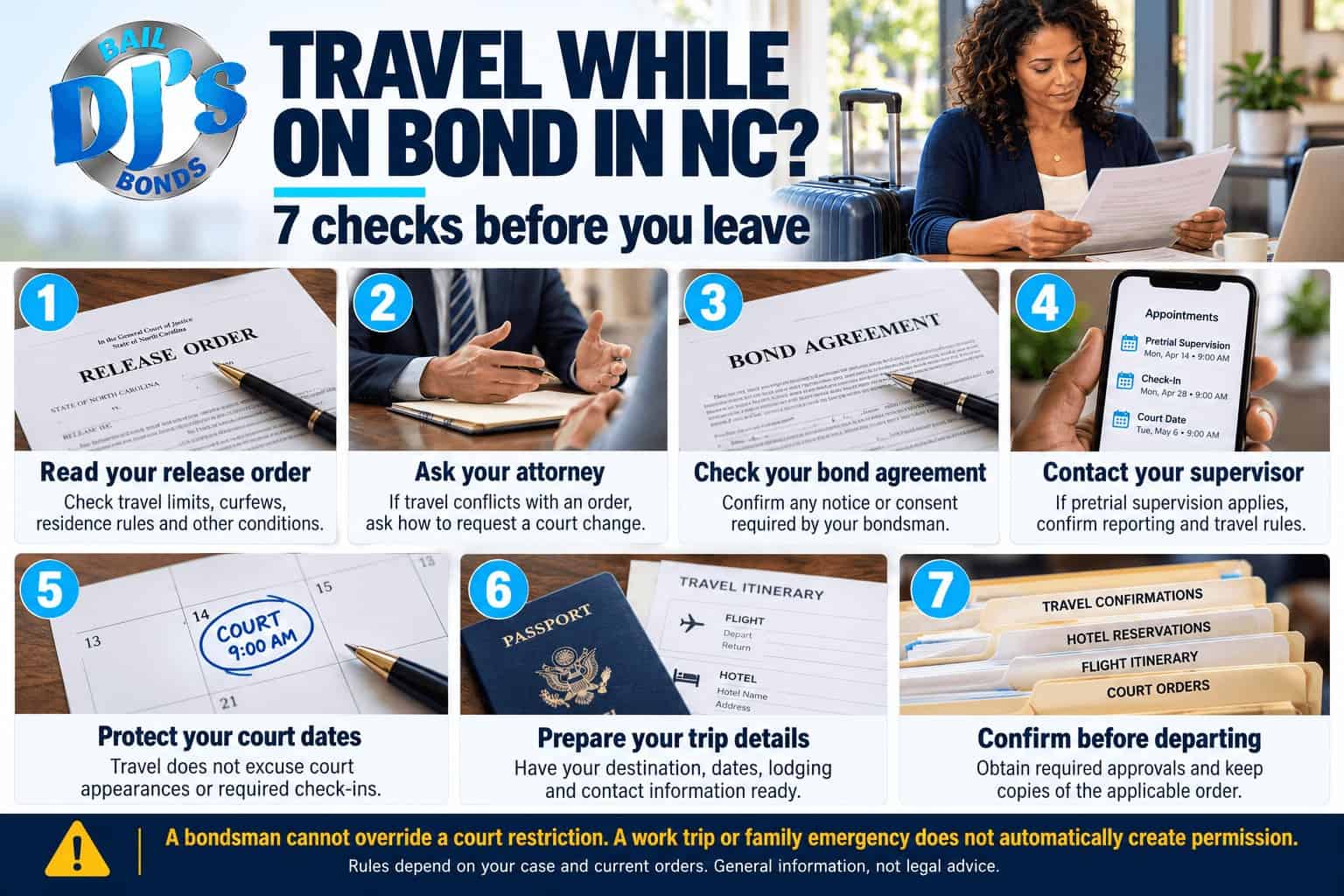
7 essential checks before you travel while on bond
The following checklist is a planning tool. It does not create a new legal requirement that every defendant obtain the same approvals. Use it to identify the conditions that apply to you and resolve any conflict before departure.
Read your current release order
Gather the complete order, attachments and any later modifications. Check travel limits, residence requirements, curfews, prohibited contact and other conditions that might affect the itinerary.
Do not assume that a condition from another person’s case applies to yours. If you cannot locate the complete paperwork, ask your attorney how to obtain the current order. Keep the case numbers organized so an older document is not mistaken for the controlling version.
Ask your attorney about the specific trip
Provide your destination, departure date, return date and reason for travel. Explain whether you will cross a county or state boundary, stay overnight, fly or travel internationally.
Ask whether the plan is consistent with the existing order. If it is not, ask what request would be appropriate and how much time the process may require. Sending a question is a useful first step, but an unanswered message does not establish that travel has been approved.
Check your bond agreement
Review the signed agreement for any requirement to notify the bonding company, obtain consent, remain reachable or report address changes. Ask about the actual language rather than assuming every company uses identical terms.
If the agreement requires notice or consent, explain the trip accurately and follow the specified process. Keep a record of what was requested and confirmed. Do not treat bond-company consent as a substitute for compliance with your court order or supervision conditions.
Confirm supervision and monitoring requirements
If supervision applies, check reporting appointments, approved schedules, monitoring instructions and any required contact during the trip. Bring the proposed itinerary to the person responsible for your supervision.
A traveler with approved work hours should ask whether those hours also cover the proposed journey, overnight stay and return. If a monitoring device is involved, ask the supervising program about applicable travel arrangements and equipment instructions. Do not disconnect or change equipment to make the trip easier.
Protect court dates and required appointments
Compare the entire trip with your court schedule and other obligations. Include the day you expect to return and a realistic margin for traffic, weather, flight changes or another interruption.
Use the North Carolina Judicial Branch court-date resources, and confirm questions with your attorney. Do not interpret an incomplete search result as permission to miss court. A request for a continuance also does not mean the appearance has already been rescheduled.
Prepare a clear, practical itinerary
List where you will go, when you will leave, where you will stay and how you can be reached. Include the reason for the trip and the expected return arrangements.
For work travel, an assignment letter or schedule may help explain the request. For an urgent family matter, ask your attorney what supporting information is useful. Share sensitive documents through an appropriate private channel; there is no need to publish your case paperwork or complete itinerary online.
Confirm the outcome before departing
Make sure any approval actually covers your destination, dates, purpose and overnight arrangements. Obtain the applicable order or other required confirmation and retain a copy you can access during the trip.
If the itinerary changes, check whether the change affects the authorization or agreement. A longer stay, added destination or different return date can create a new question. Resolve that question with the appropriate person instead of assuming the original confirmation covers every variation.
Work trips, family emergencies and out-of-state travel
The reason for a trip helps explain a request, but it does not answer every permission question. The destination, length of stay, other obligations and wording of the current order remain important.
Traveling within North Carolina
Staying inside North Carolina does not necessarily settle the issue. Review whether your conditions address a county boundary, approved residence, curfew or schedule. A trip from Raleigh to another North Carolina city may still interfere with a required appointment or overnight restriction.
Describe the complete plan when seeking clarification. “I am staying in North Carolina” leaves out whether you will be away for an afternoon or several nights. Those details help your attorney and any supervising program evaluate the actual situation.
Leaving North Carolina while on bond
If the itinerary crosses a state line, identify that clearly. Ask whether the current order permits the travel, whether the bond agreement requires notice or consent, and whether supervision creates additional steps.
A short visit to Virginia or South Carolina should not be described merely as a local drive. Give the destination and expected return time. Likewise, a family member’s assurance that the trip is harmless does not replace a review of the controlling paperwork.
Traveling for work
For an out-of-town assignment, prepare the employer’s contact information, work location, dates, hours and lodging arrangements. Explain whether the assignment is a one-time trip or recurring travel.
If a schedule changes regularly, ask how updates should be handled. Avoid assuming permission for one worksite covers every future assignment. Discuss timing with your attorney before making an irreversible commitment to an employer.
Traveling for a family emergency
A serious illness, funeral or urgent family responsibility can make a request time-sensitive. Contact your attorney promptly, explain the deadline and provide relevant supporting information when requested.
Do not assume urgency itself changes the order. If travel cannot be arranged within the applicable rules, ask about alternatives such as a shorter visit, remote participation or a different departure date. These are planning possibilities, not promises that a court will approve them.
Flying or traveling internationally
Buying a ticket, holding a passport or checking in for a flight does not answer whether the trip complies with release conditions. Discuss the itinerary before booking, including connections, return arrangements and any passport-related condition.
International travel deserves an early conversation with your attorney. Ask about the order, any other legal restrictions and whether separate advice about immigration or destination entry requirements is needed. This guide does not determine whether a particular airline, border authority or foreign country will permit your travel.
Hypothetical example: a two-day work assignment
A person released in Wake County receives a two-day assignment outside North Carolina. The trip ends before the next scheduled court date, but the person also has supervision instructions and a bond agreement.
The useful next step is to compare the trip with all applicable requirements and ask the appropriate contacts about any conflict. The absence of a court-date overlap alone does not resolve the supervision or agreement questions.
Hypothetical example: a same-day family visit
A person wants to visit a relative in another county and return that evening. The trip appears simple, but the person has a curfew and a required check-in.
Planning around the visit means confirming the relevant schedule and conditions before leaving. A short distance does not make the curfew or check-in disappear. These examples illustrate questions to ask; they are not accounts of DJ’s clients or guaranteed outcomes.
How to prepare a request to travel while on bond
Start as early as you reasonably can. A clear request helps your attorney identify the issue without repeatedly asking for missing travel details. It also gives you a better opportunity to address a conflict before departure.
There is no universal approval deadline promised by this guide. Timing depends on the case, required process and court availability. Ask your attorney about the procedure that applies rather than relying on a deadline quoted for another county or another defendant.
Information to gather
- Your full name, case numbers and the county or counties involved.
- A copy of the current release order and relevant conditions.
- The destination, purpose and proposed travel dates.
- Any overnight address and a reliable contact number.
- Transportation plans and a realistic return schedule.
- Known court dates, supervision appointments and other obligations.
- Supporting work or family information your attorney requests.
“I would like to travel to [destination] from [departure date] through [return date] for [reason]. My case is in [county], and my case number is [number]. I plan to stay at [location] and can be reached at [number].
“I have attached my current release paperwork. Would this trip comply with my conditions, or do I need to request a change? Please let me know what additional information you need and what must be completed before I leave.”
This example is a communication aid, not a court filing or automatic permission form. Your attorney can decide how to present any formal request. Do not try to resolve a disputed issue through a private conversation with the judge.
If you do not have an attorney, use the Judicial Branch’s Criminal Cases help resource to understand representation and court procedures. The clerk’s office can provide procedural information, but court staff cannot act as your legal adviser.
Travel delays, missed court and possible violations
If your return trip is delayed
Contact your attorney promptly if a canceled flight, medical issue, vehicle problem or other event threatens your return. If supervision or your bond agreement requires notice, contact the appropriate person as well.
Preserve relevant records, such as a cancellation notice, repair receipt or medical documentation. Explain the facts accurately and ask what action is needed. A message reporting the problem is not the same as a court order changing your obligations.
If travel could cause you to miss court
Do not assume you can attend remotely, have someone appear for you or obtain a new date after returning. Ask your attorney what applies to the specific hearing. The court controls whether an appearance may be excused or a matter continued.
A willful failure to appear can lead to a separate criminal charge under G.S. 15A-543. A failure to appear can also trigger bond-forfeiture procedures under G.S. 15A-544.3. These are separate issues from whether the original trip was permitted.
If you think you have violated a travel condition
Speak with your attorney promptly and provide the current order, itinerary and relevant communications. Avoid assuming that returning home automatically resolves the matter or that another payment to a bonding company removes a court issue.
Possible consequences depend on the facts and applicable process. A court may address release status, and contractual or surety issues may also arise. G.S. 15A-540 governs surrender by a surety; it should not be confused with automatic bond forfeiture for every travel disagreement.
Keep these questions separate: Did the trip violate a court condition? Did it conflict with supervision or bond terms? Did the person fail to appear? Each question may involve different facts, documents and procedures.
Travel questions for Raleigh and North Carolina bond clients
If your bond is connected with Raleigh or Wake County, start with the case documents and the attorney handling that case. Do the same for a matter in Johnston, Cumberland, Harnett or another North Carolina county. A person’s home address does not replace the need to identify the court and case involved.
For bond paperwork handled by DJ’s, the team can explain the company’s agreement and help identify what information to have ready. For advice about the legal meaning of an order or a request to change it, speak with your attorney.
Explore Raleigh bail bond assistance or DJ’s bail bond FAQs for related company information. If someone has not yet been released, eligibility and initial bond arrangements are a separate discussion from permission for a later trip.
Before visiting the Raleigh office, call to confirm what documents are needed. Keep sensitive case information in a private conversation with the appropriate agent or attorney.
Frequently asked questions about travel while on bond
Can you leave the state while on bond in North Carolina?
It depends on the current release order, applicable supervision requirements and bond agreement. Some cases involve travel restrictions or an approval process. Before crossing a state line, ask your attorney whether the itinerary complies with the order and check any notice or consent required by your bondsman.
Does every person on bond need a judge’s permission for every trip?
No universal rule in this guide requires every defendant to obtain a new court order for every trip. The question is what the existing conditions permit. If a trip conflicts with a restriction or requires approval under the order, resolve that requirement before traveling. Ask your attorney about unclear language.
Can my bondsman give me permission to travel?
Your bondsman can address consent or notice under the bonding company’s agreement. That does not authorize a violation of a court restriction. If both the agreement and the release order contain relevant requirements, you need to address each one through the appropriate process.
Can I travel to another county without leaving North Carolina?
Possibly, but staying within the state does not settle every issue. A county restriction, curfew, approved residence, supervision appointment or other condition could affect the trip. Review the actual order and schedule rather than assuming an in-state destination is automatically permitted.
Can I travel for work while my criminal case is pending?
Work travel may be possible when consistent with your conditions or after any required change is obtained. Prepare the job location, employer information, travel dates, work hours and overnight arrangements. Ask how recurring assignments or last-minute changes should be handled before committing to a schedule.
Does a funeral or family emergency automatically allow travel?
No. An urgent family situation can explain why a request needs prompt attention, but it does not automatically change a release order. Contact your attorney immediately, provide the destination and timing, and ask what can be done through the applicable process before leaving.
Can I fly while on bond?
The relevant question is whether the proposed journey complies with your conditions, not simply whether you can purchase a ticket. Review the destination, dates, return arrangements and any applicable restrictions with your attorney. Airline procedures and legal permission under a release order are separate matters.
Can I travel internationally while on bond?
Do not assume international travel is allowed. Discuss the complete itinerary, passport-related conditions and any other restrictions with your attorney before booking. Ask whether separate advice is needed about immigration or destination entry rules. Having a passport or reservation does not establish compliance with the court order.
What if my release paperwork does not mention travel?
Check the complete current order, attachments and later changes. Other conditions may affect the trip, including curfews, residence or supervision obligations. Also review the bond agreement. If the documents are incomplete or unclear, ask your attorney to clarify rather than treating silence in one page as blanket permission.
How far in advance should I request permission?
Ask as early as reasonably possible. This guide does not promise a fixed statewide deadline or approval time. The necessary procedure depends on the order, case stage and court availability. Tell your attorney the departure date immediately, particularly when work or an emergency creates a short timeline.
Can I miss court if the trip was approved?
Do not assume travel approval excuses a court appearance. A travel authorization and a change to a hearing or appearance requirement are separate matters. Confirm the exact court obligation with your attorney, and do not treat a requested continuance or planned return date as a granted change.
What should I carry during an authorized trip?
Keep identification, relevant release paperwork, any applicable travel authorization and contact information for your attorney and required supervision contacts accessible. Retain any bond-company confirmation required by your agreement. Store copies securely, and remember that carrying documents does not expand the permission those documents actually provide.
Check the paperwork before you make the trip.
DJ’s Bail Bonds provides 24/7 assistance with company bond questions. Have your name, relevant case information, travel dates and agreement ready. For legal advice or a change to court conditions, contact your attorney.
DJ’s Bail Bonds1724 S. Saunders Street, Suite 2314
Raleigh, NC 27603
Call before visiting.
Official sources and company information
- G.S. 15A-534 — Conditions of pretrial release, including travel restrictions and modification
- G.S. 15A-539 — Review of release orders by a superior court judge
- G.S. 15A-540 — Surrender of a defendant by a surety
- G.S. 15A-543 — Willful failure to appear
- G.S. 15A-544.3 — Entry of bond forfeiture
- North Carolina Judicial Branch — Criminal Cases
- North Carolina Judicial Branch — Court Dates
- DJ’s Bail Bonds — Company and owner information
This article provides general information about travel while on pretrial release in North Carolina. It is not legal advice or permission to travel. Your current orders, applicable supervision requirements and signed agreements control your situation. Consult your attorney about your case and any request to change court conditions.