
How to Verify a North Carolina Bail Bondsman License
If you need to verify bondsman license information in North Carolina, start with the official North Carolina Department of Insurance record before you share personal details, sign paperwork, or send payment. Quick Answer: use the NC DOI bail bondsmen licensing page to check the person’s name, NPN if provided, license status, and whether the record matches the person contacting you. A legitimate conversation should leave room for questions, written terms, and careful review. If anything does not match, pause and ask for clarification before moving forward.
This guide is written for family members, friends, defendants, and potential cosigners who are trying to make a careful decision during a stressful moment. It explains how a license lookup works, why a qr code should be treated as a starting point rather than the whole verification process, how an agent portal or official record can help confirm identity, and which license status details deserve the most attention.
For Raleigh and Wake County families, the same careful approach applies whether the person in custody was arrested in Raleigh, Cary, Garner, or elsewhere in Wake County. The custody location matters for the bond process, but licensing is a statewide North Carolina issue. If you want to understand DJ’s Bail Bonds’ approach to calm, local assistance before you contact anyone, you can read more about DJ’s Bail Bonds.
How to verify bondsman identity before sharing information
The safest order is simple: verify the license first, then compare the official record to the person contacting you, then read the written agreement before signing or paying anything. Do not rely only on a business card, social media profile, paid advertisement, vehicle decal, or someone saying they “work with the jail.” Marketing can help you find a company, but it is not the same as license verification.
The NC Department of Insurance bail bondsmen licensing page says you can look up a bail bondsman with an NPN number, scan a qr code for license status, and submit a license photo. That makes the NC DOI page the right starting point when someone claims to be a North Carolina bail bondsman or runner.
Before you begin, collect the information that helps you compare records carefully:
- The person’s full name as they give it to you
- The company name they say they represent
- Their NPN number, if they provide one
- A photo of the license or ID card, if offered
- The phone number, email address, or website they are using
- The defendant’s full name, date of birth, custody location, booking number if known, charge, and bond amount if a judicial official has set one
You are not being difficult by asking for this information. A legitimate bail bond conversation often involves sensitive personal and financial details, especially when a cosigner (indemnitor) may be responsible for the bond. Taking a few minutes to check the record can protect the person in custody, the cosigner, and the family member trying to help.
Step 1: Start with the NC DOI license lookup
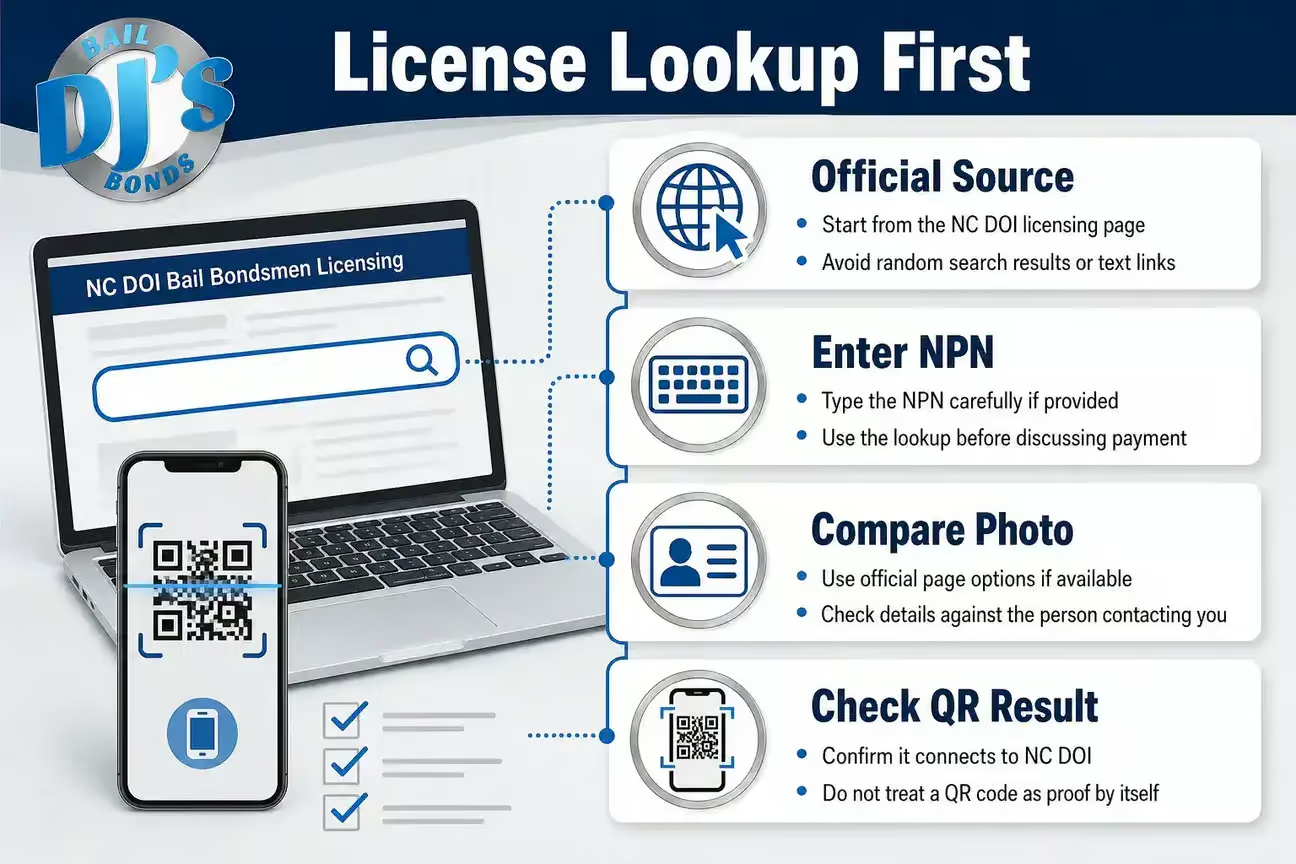
The license lookup should come before any payment conversation. Search from the official NC DOI bail bondsmen licensing page, not from a random search result, text-message link, or third-party directory. A license lookup gives you a more reliable way to compare the name, license status, and identifying details than a screenshot or social profile.
If the person gives you an NPN, enter it carefully. If they give you a license photo, use the official page’s available options to compare the information. If they show a qr code, scan it only if you are comfortable doing so and still check that the resulting page is connected to the official NC DOI source. A qr code is convenient, but it should not replace your own judgment.
The license lookup process is especially useful when you are contacted unexpectedly. Families sometimes receive calls or messages after an arrest because many people are urgently searching for help at the same time. A calm, legitimate bondsman should understand why you want to verify the record first.
Use the license lookup more than once if something changes. For example, if you first speak with one person and later receive payment instructions from another, compare each claimed name or company detail against the official record and the written agreement. The license lookup is not just a one-time box to check; it is part of staying in control of a sensitive transaction.
Step 2: Compare the name, NPN, and license status
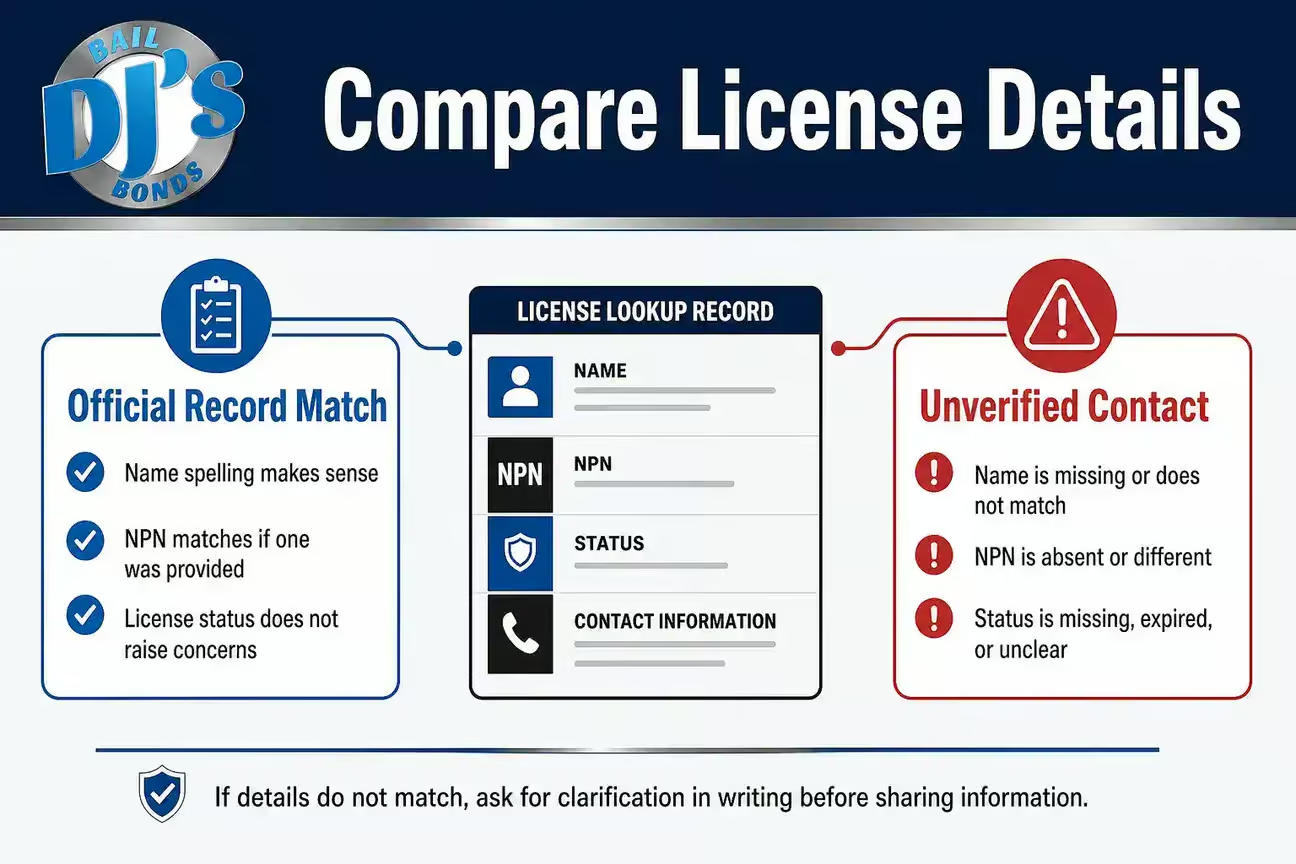
Once you find a record, slow down and compare the details. The spelling of the name should make sense. The NPN should match if one was provided. The business or contact information should not create confusion. The license status should not raise concerns. If the record is missing, unclear, expired, lapsed, or otherwise not current, pause before giving personal or financial information.
Do not accept “the system is wrong” as the only explanation. Online systems can have timing issues, and a person may need to clarify something with NC DOI, but that is exactly why you should not feel pressured. Ask the person to explain the mismatch in writing or direct you to the official record that confirms their authority.
The license status is important because licensing is not the same as popularity. A person can have a polished website, strong advertising, or familiar local name recognition and still need to be checked against the official record. A license lookup is about the person’s authority to act in the bail bond role, not whether the advertisement sounds confident.
If you are comparing several bondsmen, use the same process for each. Search the official record, compare details, ask for written terms, and avoid making a decision based only on urgency. A family emergency can make any delay feel uncomfortable, but a careful license status check is part of responsible consumer safety.
Step 3: Use the qr code without stopping there
A qr code on an identification card can be helpful when it points you to official license information. It may reduce typing errors and help you view a record quickly. Still, a qr code is only useful if you confirm where it takes you and what the record says. Do not scan a code and assume everything is fine without checking the source and the details.
When you scan a qr code, look for signs that the page is connected to NC DOI or the official license record. Compare the name, NPN, and license status to the person in front of you or the person contacting you by phone. If the qr code leads to a generic image, a private form, a payment page, or a page that does not clearly show the official record, treat that as incomplete verification.
The qr code should also match the context. If someone says they are a bail bondsman but the record does not match the person, company, or role being claimed, ask questions. If the person becomes irritated because you want to verify the record, that reaction itself is a reason to slow down.
Do not send sensitive documents through a link just because it came after a qr code scan. A family member may need to share identifying information later in the process, but it should be through a trusted company channel and after you are comfortable that the entity and person are legitimate. DJ’s Bail Bonds offers secure bail bond forms for paperwork when a family is ready to begin that step, but no one should feel rushed into forms before they understand who they are dealing with.
Step 4: Understand the agent portal and official record
You may hear people refer to an agent portal, licensing portal, or official record. The wording may vary, but the practical question is the same: does the official licensing information support what the person is telling you? The agent portal or lookup record should help you confirm identity, license status, and whether the details match the person asking for your information.
An agent portal is not a substitute for a written agreement. It helps you check licensing. It does not tell you whether you should cosign, whether collateral may be requested, whether a payment arrangement will be approved, or whether the person in custody will be released. Those issues depend on the court order, custody location, the written agreement, and the individual case.
Be cautious if someone tries to blur the line between official licensing and sales language. “I am licensed,” “I can handle this,” and “I have done many bonds” are not enough by themselves. The official record should be consistent with the claim. The written agreement should set out the terms. The detention facility controls release processing after an eligible bond is posted, and holds or other charges can delay or prevent release.
If you are unsure whether the agent portal or license lookup result matches what you were told, ask the company to help you identify the correct official record before moving forward. You can also contact DJ’s Bail Bonds with general process questions after you have gathered the defendant’s full name, date of birth, custody location, booking number if known, charge, and bond amount.
Step 5: Read the written agreement before signing
License verification helps you decide whether the person is properly identified, but it does not replace careful review of the written agreement. A cosigner (indemnitor) may be taking on serious financial responsibilities. Read every page before signing, ask what each obligation means, and keep a copy of anything you sign.
The NC DOI indemnity agreement form includes language showing that an indemnitor may guarantee payment of the bond and agree to indemnify and hold harmless the bondsman if forfeiture occurs. That is a serious commitment. It is not just a character reference or a promise to remind the defendant about court.
Look for the premium, payment terms, collateral terms if any, court-date obligations, and what happens if the defendant misses court. Collateral is reviewed case by case and should be set out in the written agreement. Do not rely on a verbal promise that contradicts the document. If something is unclear, ask for an explanation before you sign.
North Carolina law caps the bondsman’s premium at 15% of the bond’s face amount under G.S. 58-71-95. The exact premium and payment terms are controlled by the written agreement. The premium is a non-refundable fee for the bondsman’s service; it is different from a cash bond paid directly to the court.
Which license status details matter most
When you review license status, focus on whether the official record supports the person’s ability to act in the role they are claiming. Do not overcomplicate the process, but do not skip the basics. The license status should be current and should not contradict what you were told.
Important license status details include:
- Name match: The person’s name should match the official record or be clearly explainable.
- NPN match: If an NPN was provided, the license lookup should match it.
- Role match: The record should support the bail bond role being claimed.
- Status clarity: If the license status is not current or is unclear, pause before sharing sensitive information.
- Contact consistency: The person’s phone number, business name, website, and paperwork should not conflict in a way that cannot be explained.
North Carolina bail bondsmen are regulated under G.S. Chapter 58, Article 71. That legal framework is why families should rely on official licensing information instead of informal assurances. Regulation does not mean every decision is risk-free, but it gives consumers a concrete place to begin verification.
A license lookup also helps you separate individual licensing from company familiarity. You might recognize a company name but still want to confirm the individual person who is contacting you. You might also speak with a professional company representative and later receive documents from another team member. Ask how the person is connected to the company and make sure the paperwork is consistent.
Keep notes. Write down the date and time you checked the license status, the name searched, the NPN if provided, and any questions you asked. If you later need to explain a concern, clear notes are more useful than memory during a stressful moment.
Red flags that should make you pause
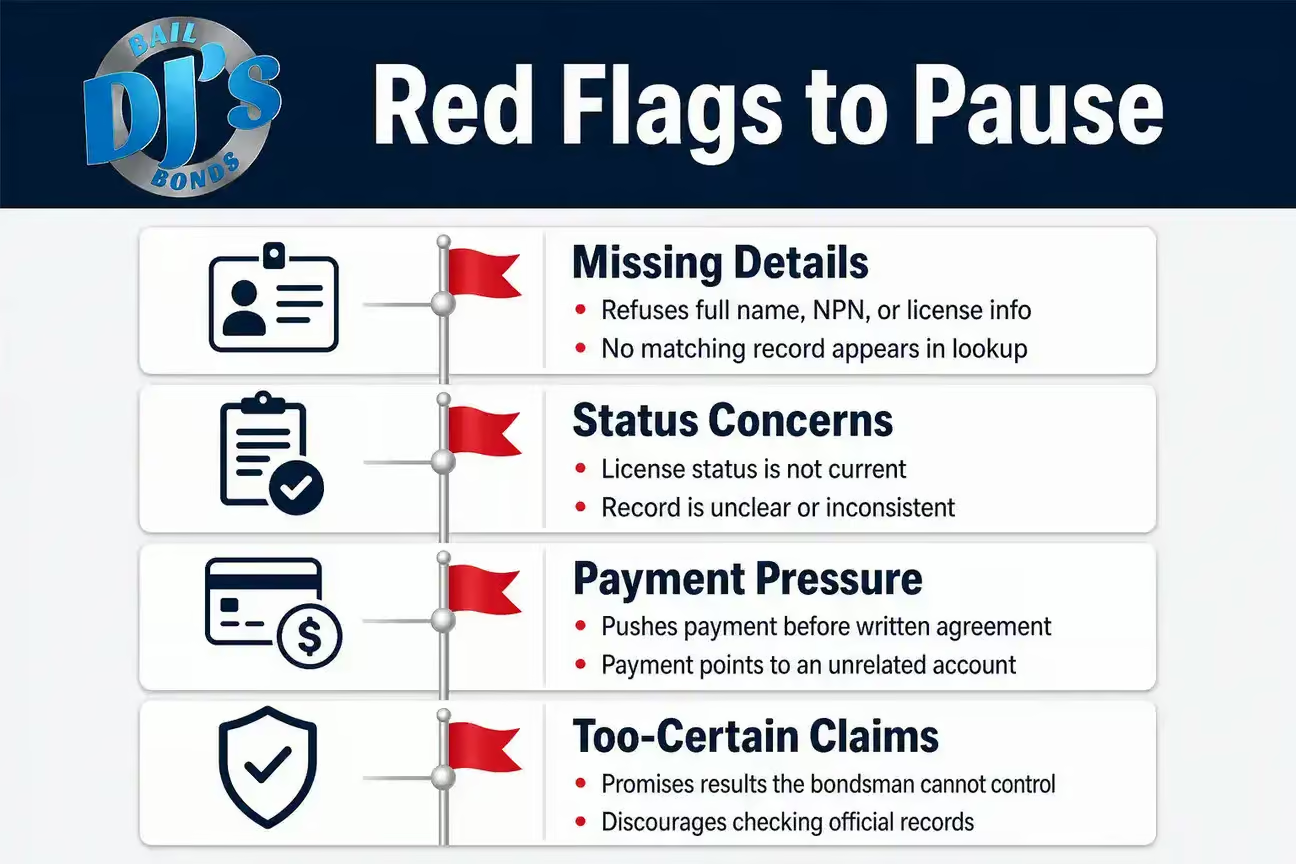
Not every confusing detail means something is wrong. Names can be misspelled, family members can misunderstand a conversation, and online systems can be hard to navigate. Still, certain patterns should make you slow down before sharing personal or financial information.
Watch for these red flags:
- The person refuses to provide a full name, NPN, or license information.
- The license lookup does not show a matching record.
- The license status appears not current, unclear, or inconsistent with the person’s claim.
- The person pressures you to pay before you can read the written agreement.
- The payment instructions point to an unrelated person or account without a clear explanation.
- The person promises a specific release time.
- The person says they can lower bail, change court conditions, or remove a hold.
- The person tells you not to contact the company directly or not to verify the record.
A legitimate bail bond process should make space for questions. You should be able to ask what the premium covers, what the cosigner is promising, whether collateral is being requested, and what happens if the defendant misses court. You should also be able to ask what the bondsman can and cannot control.
Be especially careful with urgency language. Families are often worried about a loved one in custody, and pressure can make people act quickly. A bondsman cannot control the jail’s release timing. The detention facility handles release processing after the bond is posted, and holds, other charges, or conditions can delay or prevent release.
Marketing claims are not the same as license verification
Advertising can help you find a company, but it cannot prove current licensing. A website, online review profile, sponsored listing, or social media page may be useful background, yet it should never replace a license lookup. You are looking for official confirmation, not just a polished message.
Use marketing claims as prompts for questions. If a company says it offers North Carolina bail bond help, ask how the bond process works. If someone says they are available by phone, ask what information they need from you. If someone says paperwork can begin, ask to see the written agreement before signing. If a claim sounds too broad or too certain, verify it against official records and the court order.
DJ’s Bail Bonds provides bail bond services for eligible North Carolina surety bonds and phone assistance at 919-986-1547. That phone help is available 24/7, but no bondsman can promise that a bond will be approved, posted, or processed by the detention facility within a specific time. Eligibility, paperwork, custody location, holds, and court conditions all matter.
If the defendant is in Wake County, local context can matter for court and detention logistics. You can review information about Raleigh bail bonds and Wake County bail bonds to understand how DJ’s Bail Bonds discusses the local process. Licensing verification, however, remains a North Carolina DOI issue rather than a city-by-city marketing claim.
What a bondsman can and cannot do
A clear understanding of limits protects consumers. A bondsman can explain the surety bond process, review eligibility, prepare the written agreement, discuss cosigner responsibilities, and post an eligible surety bond if the case and paperwork qualify. A bondsman can also explain what information is needed from the family and what the written terms mean in plain language.
A bondsman cannot set bail. A bondsman cannot lower bail. A bondsman cannot change a judge’s or magistrate’s release conditions. A bondsman cannot remove holds, detainers, or court restrictions. A bondsman cannot control the detention facility’s release timing. If someone promises those things, treat it as a serious warning sign.
The court controls release conditions under North Carolina pretrial-release law. The detention facility controls release processing. The written agreement controls the private bond-service relationship between the bondsman, defendant, and cosigner. These are separate roles, and keeping them separate helps you spot claims that do not make sense.
Missed court dates also belong in the “take seriously” category. The N.C. Judicial Branch missed court date page explains official court information for what can happen when a court date is missed. Consequences can include an order for arrest and bond forfeiture processes, depending on the case and court action. If you have legal questions about a missed court date, speak with a licensed North Carolina attorney.
What a cosigner should check before agreeing
A cosigner is often trying to help someone they care about, but the role can carry financial obligations. Before agreeing, verify the bondsman, read the indemnity agreement, ask about collateral if any, and make sure you understand the defendant’s court-date responsibilities. Do not sign just because another family member says it is routine.
Ask these questions before signing:
- What is the bond amount set by the court?
- What is the premium under the written agreement?
- Is collateral being requested, and if so, what does the written agreement say?
- What happens if the defendant misses court?
- What information must the defendant keep updated?
- Who should the cosigner contact with questions after release?
- What documents will the cosigner receive after signing?
The written agreement should not be treated like a formality. If you do not understand a provision, ask. If the answer is still unclear, pause. A respectful bondsman should be willing to explain the process without pressuring you into a decision you do not understand.
Use a simple verification checklist
When a family is anxious, a checklist can keep the conversation focused. Use this table to separate official verification from private agreement terms and court-controlled issues.
| Item to check | Where to check it | Why it matters |
|---|---|---|
| Name and NPN | NC DOI license lookup | Confirms whether the person’s identifying details match the official record |
| License status | NC DOI official record or agent portal | Helps you decide whether to continue before sharing sensitive information |
| Business and contact details | Company website, direct phone contact, written agreement | Helps identify mismatches or suspicious payment instructions |
| Premium and payment terms | Written agreement | Shows the exact premium and terms; North Carolina law caps the premium at 15% of the bond’s face amount |
| Cosigner obligations | Indemnity agreement and written bond documents | Explains what the cosigner may be promising financially |
| Court dates and conditions | Court paperwork and official court resources | Helps the defendant and cosigner understand obligations after release |
| Release processing | Detention facility | The facility controls release processing; the bondsman cannot promise timing |
You do not need to know every legal term to use this checklist. The goal is to slow the process down enough to confirm identity, understand the agreement, and avoid promises that no bondsman can make.
When to call, and what to have ready
After you complete the basic verification steps, a phone call can help you understand the next practical step. For DJ’s Bail Bonds, call 919-986-1547 for 24/7 phone help. Have the defendant’s full name, date of birth, custody location, booking number if known, charge, and bond amount ready. Calling does not guarantee approval, posting, or release timing; it simply helps the team understand the situation and explain available next steps.
If you are not ready to call, use the verification checklist first. Compare the license status, review the written terms, and write down questions. If you are comfortable moving forward with paperwork after speaking with the team, you can use the secure forms page rather than sending sensitive information through an unverified channel.
For general process questions, the bail bond FAQs can help with common terms, but the written agreement and the court order control the specific case. If the case involves legal strategy, possible defenses, or what to say in court, speak with a licensed North Carolina attorney.
Final thoughts on license status and trust
The best time to verify bondsman information is before you share sensitive details, sign an indemnity agreement, or send payment. Use the NC DOI license lookup, compare the name and NPN, review the license status, treat a qr code as a helpful tool rather than a shortcut, and make sure the written agreement matches what you were told.
Trust is built through clear records, patient answers, and honest limits. A bondsman should not promise a release time, claim to lower bail, or discourage you from checking the official record. Careful verification protects the defendant, the cosigner, and the family member trying to make a responsible decision under pressure.
This article is general information about the North Carolina bail process, not legal advice. Bond eligibility, conditions and release timing depend on the court order, the detention facility and the individual case.
Frequently Asked Questions
How do I verify a bondsman in North Carolina?
Use the official NC Department of Insurance bail bondsmen licensing page. Search by the information the person gives you, such as name or NPN, and compare the license status and identifying details to the person contacting you. Do this before sharing personal information, signing documents, or sending payment.
What should I look for in the NC DOI license record?
Look for a name match, NPN match if one was provided, a role that fits the bail bond work being claimed, and a license status that does not raise concerns. If the record is missing, unclear, or inconsistent, pause and ask for clarification before moving forward.
Is a qr code enough to confirm a license?
A qr code can be useful if it takes you to official license information, but it should not be your only check. Confirm the page source, compare the name and NPN, and review the license status. If the qr code leads somewhere unrelated or unclear, treat the verification as incomplete.
What if an agent portal or record does not match what I was told?
Do not ignore the mismatch. Ask the person or company to explain the difference and direct you to the correct official record. If the answer is unclear or you feel pressured to continue anyway, wait before sharing documents or payment information.
What does a cosigner or indemnitor actually promise?
A cosigner may be promising financial responsibility connected to the bond, including obligations described in the indemnity agreement. Read the agreement carefully, ask questions about premium, collateral if any, and missed-court consequences, and keep a copy of anything you sign.
Can a bondsman change bail or release conditions?
No. A bondsman cannot set bail, lower bail, change a judge’s or magistrate’s conditions, remove holds, or control the jail’s release processing. The bondsman’s role is separate from the court’s authority and the detention facility’s release process.
What is the difference between a premium and a cash bond?
The premium is the non-refundable fee for the bondsman’s service, and North Carolina law caps it at 15% of the bond’s face amount. A cash bond paid directly to the court is different. The written agreement should explain the exact premium and payment terms for the surety bond.
What happens if a court date is missed?
A missed court date can lead to serious court consequences, which may include an order for arrest and bond forfeiture processes depending on the case. The defendant and cosigner should track court dates carefully and contact a licensed North Carolina attorney for legal advice.