

Introduction: The Phone Call Nobody Wants to Receive
It’s 2:00 AM. Your phone rings. The caller ID shows an unfamiliar number, but you answer anyway. On the other end, a voice says: “I’m calling from the [Wake County Detention Center]. Your [family member] has been arrested. You need to come or arrange bail.” Your heart pounds. Your mind races. What do you do first? Who do you call? How much will it cost? And how long will they be in jail?
First, take a breath. You are not alone. Thousands of North Carolina families face the same situation every year. With the right information and a trusted bail bondsman, you can navigate this crisis calmly and get your loved one home within hours – not days.
This guide walks you through exactly what to do after an Arrest in North Carolina, from the first phone call to the moment your loved one walks through the front door. We cover the five essential steps, common mistakes to avoid, and how a 24/7 bail bondsman like DJ’s Bail Bonds (919-986-1547) can make all the difference.
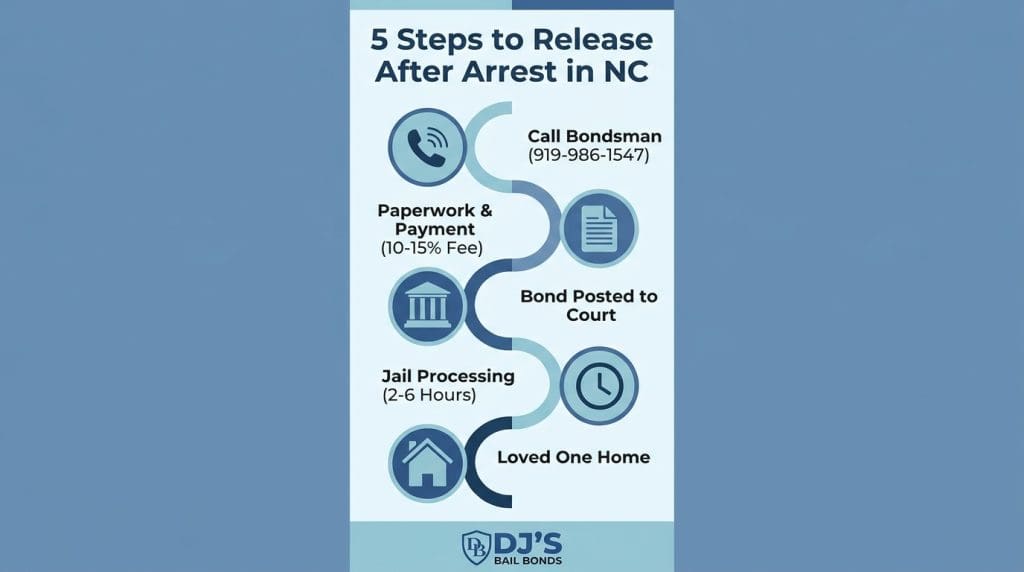
Step 1: Gather Critical Information Before You Do Anything Else
The first few minutes after learning of an arrest are chaotic, but the information you collect now will determine how fast the release happens. Do not start calling bondsmen or lawyers until you have the following facts written down:
Full legal name of the arrested person (including middle name or suffix like Jr./Sr.).
Date of birth – essential for the jail to locate the correct record.
The exact facility where they are being held – In Wake County, that is usually the Wake County Detention Center at 3301 Hammond Road, Raleigh. Other counties have their own jails. If you are unsure, ask the caller or the jail operator.
Booking number – if the caller provided it. If not, the bondsman can look it up.
Charges – even a vague description (e.g., “DWI” or “assault”) helps. The precise charges will be set by a magistrate after booking.
Bond amount – often not set immediately. The magistrate will determine bail within hours of booking. Until then, a bondsman can only prepare.
Keep this information on a notepad or in a note on your phone. You will need to share it with the bail bondsman and possibly an attorney.
Step 2: Call a Licensed North Carolina Bail Bondsman Immediately – Do Not Wait for the Magistrate
Many families make the mistake of waiting for the magistrate to set bail before calling a bondsman. That wastes precious time. A good 24/7 bail bondsman can begin the verification process, prepare paperwork, and be ready to post the bond the moment the amount is set.
Call DJ’s Bail Bonds at 919-986-1547 – we answer 24 hours a day, 365 days a year. Our licensed agents will:
Use your information to locate the defendant in the jail system.
Explain the bond process in plain English.
Give you an estimated premium (10-15% of the expected bond amount).
Start the cosigner paperwork so that when the bond is set, we can post it within minutes.
Do not call multiple bondsmen at once. Choose one reputable agency and stick with them. Jumping between agencies only creates confusion and delays.
Step 3: Understand How Bail Works in North Carolina – The 15% Premium Cap
North Carolina law (N.C. Gen. Stat. § 58-71-1 et seq.) strictly regulates bail bondsmen. One of the most important protections for families is the 15% premium cap. A bondsman cannot charge more than 15% of the total bond amount. Most agencies, including DJ’s Bail Bonds, typically charge between 10% and 15%, depending on the level of risk.
Example: A Wake County magistrate sets bail at $25,000 for a non-violent felony charge, such as breaking and entering. The maximum premium you could be charged by a bondsman is $3,750 (15% of $25,000). However, DJ’s Bail Bonds often offers rates closer to 10%, which would be about $2,500.
This fee is non-refundable because it pays for the service of posting the full $25,000 bond and for assuming the financial risk that the defendant will appear in court.
If you have the full $25,000 in cash, you could pay it directly to the court as a “cash bond.” That money would be returned to you (minus administrative fees) after the case concludes, as long as all court appearances are made. However, most families do not have thousands of dollars in liquid cash available—especially in urgent situations. That’s why a surety bond through a licensed bondsman is often the most practical solution.

Step 4: Complete the Bond Agreement and Provide Collateral if Needed
Once you agree to move forward, the bondsman will ask you (or the designated cosigner) to sign a bond agreement contract. This is a legally binding document. Read it carefully. It will state:
The total bond amount.
The premium you are paying (non-refundable).
Any collateral required (car title, jewelry, property deed, etc.).
The cosigner’s responsibilities (ensuring the defendant appears in court).
The consequences of a failure to appear (forfeiture and full liability).
Collateral is not always required. For low‑risk bonds (e.g., $2,500 on a minor misdemeanor), many agencies accept the premium alone. For higher bonds or defendants with a history of missed court dates, the bondsman may ask for collateral equal to the full bond amount. This collateral is returned once the bond is exonerated (the case is over and all appearances were made).
After signing, the bondsman will electronically or physically post the bond with the jail. At that moment, the defendant is officially released from the bond obligation – but they remain in custody until the jail completes its processing.
Step 5: Wait for Release – What to Expect at the Jail
Posting the bond is only half the battle. The jail must now process the release paperwork. This typically takes 1 to 4 hours in Wake County, though it can be longer on weekends, holidays, or when the jail is overcrowded.
During this wait:
Do not call the jail repeatedly. They will not give you updates.
Stay by your phone. The defendant may call you when they are about to be released, or the jail may call the cosigner.
Prepare to pick them up at the designated release door. For the Wake County Detention Center, that is usually the front lobby entrance on Hammond Road.
Bring identification. You may need to show ID to pick up the defendant’s personal belongings.
Once released, the defendant will receive a piece of paper called a release order or bond receipt. They must keep this document safe and bring it to every court appearance.
After Release: Court Dates, Compliance, and Avoiding Forfeiture
Your responsibility does not end when your loved one is released from jail. The bond remains active until the judge “exonerates” it—typically at the conclusion of the criminal case. During this time, the defendant must:
- Attend every scheduled court hearing (it’s important to write down all dates immediately)
- Avoid committing any new crimes while out on bond
- Comply with any special conditions set by the judge (such as no contact with an alleged victim or surrendering a passport)
If the defendant misses even a single court date, the judge will issue a bench warrant and the court will declare a bond forfeiture. At that point, the cosigner becomes responsible for the full bond amount.
In North Carolina, the bondsman and cosigner generally have about 150 days to locate the defendant and return them to court in order to set aside the forfeiture. If they are unable to do so, the cosigner may lose any collateral provided and could be held liable for the full bond amount.
For a deeper explanation of this process, read our complete guide: How to Choose a Reliable Bail Bondsman (https://www.djsbailbonds.com/how-to-choose-a-reliable-bail-bondsman/).
Why Speed Matters If You Are Arrested in North Carolina– and How DJ’s Bail Bonds Helps
Every hour your loved one sits in jail, they are at risk of losing their job, missing family obligations, and suffering emotional distress. A fast, professional bail bondsman can reduce that time from days to hours. DJ’s Bail Bonds has been serving North Carolina since 2011. Our agents are:
Licensed by the North Carolina Department of Insurance.
Available 24/7 – nights, weekends, holidays.
Compassionate – we treat every family with respect, never judgment.
Transparent – no hidden fees, no surprises.
We serve all 100 counties, including Raleigh, Wake County, Fayetteville, Cumberland, the Triad, Charlotte, and beyond.
Get help fast, get answers now:
- Call 919‑986‑1547 (24/7)
- Visit DJ’s Bail Bonds to see services, FAQs, and contact info
- Contact us directly for Raleigh, Wake County, Fayetteville, Cumberland, DWI, gun possession, and disorderly‑conduct bail bonds
You don’t have to make this decision alone. We’re here to walk you through it, point you toward the right steps, and help get your loved one home as quickly and safely as possible.
FAQS: What to Do When Someone Is Arrested in North Carolina
What is the first thing I should do when I learn someone is arrested?
Stay calm and immediately call a licensed 24/7 bail bondsman like DJ’s at 919-986-1547. Have the defendant’s full name, location, and charges ready.
How long does the booking process take in North Carolina?
Typically 2 to 8 hours, including fingerprinting, photographing, and magistrate review. Weekends and holidays cause delays.
Can I bail someone out of jail in the middle of the night?
Yes. Magistrates are on duty 24/7. A 24/7 bondsman can post bond at any hour, though jail release may still take a few hours.
Do I need a lawyer to get someone out on bail?
No. A licensed bondsman handles the release. However, the defendant should hire a criminal defense attorney for the case.
How is the bail amount determined?
The magistrate considers crime severity, criminal history, community ties, and flight risk. Violent felonies receive higher bail.
What information does a bail bondsman need from me?
Full name and DOB, exact jail location, booking number (if available), and charges.
Why does release sometimes take several hours after bail is posted?
Jail administrative processing (verifying bond, retrieving property) takes 1–4 hours, longer during high volume.
Can I get a refund on money paid to a bail bondsman?
No. The premium is a non-refundable service fee regulated by North Carolina law.
What if the bond amount is too high for me to afford?
Licensed bondsmen offer payment plans (sometimes as low as 5% down) and accept collateral.
Does DJ’s Bail Bonds serve counties outside of Wake County?
Yes. We serve all 100 North Carolina counties, including Fayetteville, Cumberland, the Triad, Charlotte, and Asheville.