
North Carolina • Family guide
The case ended. You helped a family member get out of jail months ago, and now you want the cash or property you pledged to the bail bond agency back. Do you collect it when the defendant leaves jail, when the charges are dismissed, or when the court closes the bond? And what can you do if you cannot get a clear answer?
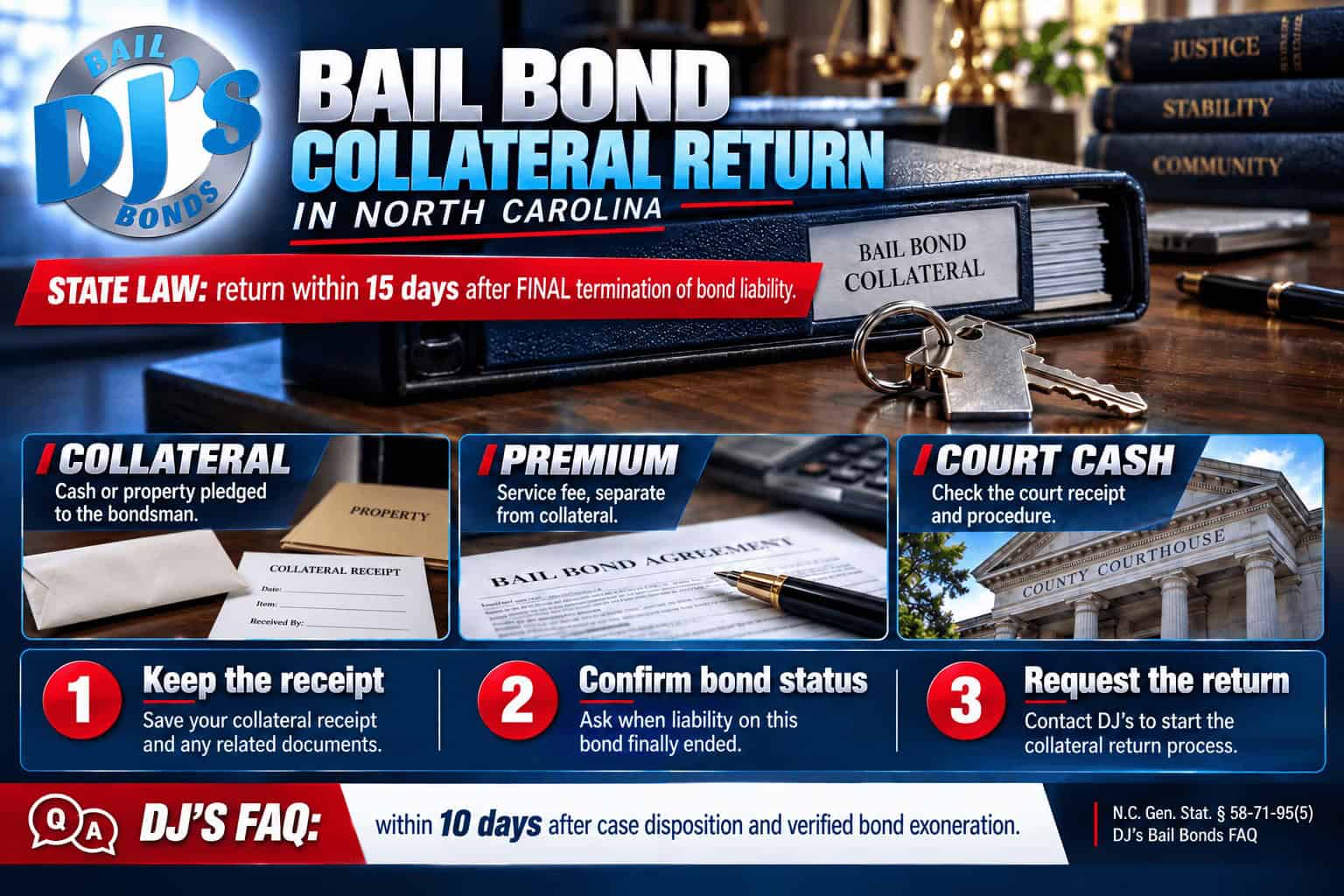
Quick answer: For collateral held by a North Carolina bail bondsman, the legal deadline is 15 days after final termination of liability on the bond—not 15 days after release from jail or simply 15 days after someone tells you a court date is over. N.C. Gen. Stat. § 58-71-95(5) requires collateral to be reasonable in relation to the bond amount and returned under the same conditions in which it was received. DJ’s Bail Bonds’ FAQ says its collateral is returned within 10 days once the case is disposed and the agency has verified bond exoneration. Confirm the status of your bond, the documentation the agency needs, and who is entitled to receive the property.
This guide concerns collateral given to a bondsman for a North Carolina bail bond. If you deposited cash directly with a court, that is a different arrangement with different procedures. If you paid a bondsman’s premium, that payment is distinct from returnable collateral. Your receipt and signed agreement should tell you what each payment or item was for.
The central question in a bail bond collateral return in North Carolina is whether the liability on the particular bond has finally ended. Keep that question separate from whether one charge shows as dismissed or the person is no longer in custody.
First, identify what you actually paid or pledged
Families often say “bail money” to describe three different things. Only one may be the collateral held by the agency.
| Item | Who generally receives it? | What to check when the case ends |
|---|---|---|
| Bail bond premium | The licensed bondsman for the bonding service | Read the fee receipt and agreement. The premium is separate from the bond amount and pledged collateral; the end of the case does not itself turn the premium into collateral. |
| Collateral or indemnity security | The bondsman as security for an eligible bond, if required | Ask whether bond liability has finally terminated and how the same cash or property interest will be released or returned under the agreement and state law. |
| Cash deposited with the court | The court or official taking the appearance bond | Follow the court’s bond type and receipt. The North Carolina appearance-bond form distinguishes cash deposited for a defendant’s obligation from a surety’s cash deposit; the named person and purpose matter. |
The North Carolina bail-bond statute allows a bondsman to accept a premium of no more than 15% of the face amount of the bond, plus reasonable collateral security or indemnity. A $1,000 payment does not tell you which category it belongs to. Your written receipt should.
DJ’s FAQ says the agency accepts cash and property as collateral and does not accept vehicles, electronics, or expensive jewelry as collateral. If you were asked about a different item, verify the actual agreement and the person or business holding it rather than assuming DJ’s has possession.
What should the collateral receipt tell you?
A useful receipt identifies who provided the collateral, the bond or defendant associated with it, and the nature of what was received. North Carolina’s appearance-bond form separately asks a professional bondsman to disclose the name of the collateral provider, the nature of the collateral, and its value in an affidavit. The agency’s own receipt and your signed collateral agreement remain the documents to use when requesting return from the agency.
If the paperwork calls the money a “premium,” “deposit,” “collateral,” or “security” in different places, do not rely on the label of one line alone. Ask for a written breakdown of the premium charged, the amount or property held as security, the person who supplied it, and the condition for its release. If a family member paid the premium while you pledged your property, keep those transactions distinct. This is especially important if a different person is named on the bond paperwork.
The difference also determines whom to contact. A bondsman can address security it holds under its agreement. A court clerk handles cash accepted on the court bond. The court’s form provides separate instructions for a defendant’s cash appearance bond and a surety’s cash deposit, including different recipients when the bond is discharged. Do not submit the same refund request to both as though the two deposits were interchangeable.
What starts North Carolina’s 15-day return period?
The statutory clock is tied to final termination of liability on the bond. The defendant’s release from jail begins the period during which the bond secures future appearances; release does not end the surety’s responsibility. Even a family member’s report that “the case is over” may be incomplete if another covered appearance remains, a district-court judgment has been appealed, a forfeiture is unresolved, or the bond has not otherwise been discharged.
The North Carolina Judicial Branch appearance-bond form states that the bond ordinarily binds the defendant and surety through proceedings in the trial courts until judgment in district court from which no appeal is taken or judgment in superior court, unless it ends earlier by law or court order. This is why an arrest date, a single hearing, or a verbal case-status update is not a reliable start date for every collateral return.
Ask the agency these two separate questions:
- Has the bond’s liability finally terminated? If yes, on what date and according to which court record or order?
- What is required to return or release my collateral? Ask who will receive it, what paperwork must be completed, and how delivery will be documented.
The court record and agency agreement answer different questions. The court record helps establish the bond status; the agreement and receipt help establish what you pledged and to whom it should be returned. You can start with the North Carolina Judicial Branch court-record search or contact the clerk for the relevant county, but confirm any uncertain bond status with the court or a North Carolina attorney.
Does a dismissal automatically return collateral?
Not always immediately. A dismissal of all charges covered by the bond may support termination or a request to set aside a forfeiture in particular circumstances, but you still need to verify the bond’s actual status, including any appeal, other covered file number, or forfeiture proceeding. N.C. Gen. Stat. § 15A-544.5 sets out specific reasons and procedures for setting aside a forfeiture. Do not treat a screenshot of one dismissed charge as proof that every bond obligation is cleared.
What if the person missed court?
A failure to appear can lead to forfeiture proceedings. That may change whether the surety’s liability has ended and whether the collateral can be returned yet. Do not assume either that the collateral is permanently lost or that it must be released immediately. Ask for the current forfeiture status and written explanation, and speak with a North Carolina criminal defense attorney if the court action is disputed. DJ’s separate guide to a missed North Carolina court date focuses on the defendant’s failure-to-appear issue; this article focuses on the collateral holder’s return request.
DJ’s stated timeline versus the statutory deadline
Two time periods appear in public information, and they describe different things:
- North Carolina law: A bondsman must return returnable collateral within 15 days after final termination of liability on the bond. The statute also requires collateral to be reasonable in relation to the bond amount and returned under the same conditions as requested and received. Read § 58-71-95(5).
- DJ’s published FAQ: DJ’s says that once the case is disposed and it has verified bond exoneration, collateral will be returned within 10 days. Its FAQ also asks the provider of collateral to notify DJ’s of the case resolution to begin the return process. Read the current DJ’s FAQ.
Do not silently substitute the FAQ’s 10-day statement for the statutory 15-day clock. Ask DJ’s what date it considers the bond cleared and how it applies its stated process to your agreement. If the agency cannot confirm final termination yet, ask what court record or event it is still waiting for.
How should you count the dates?
Write down the event and the date rather than treating “case closed” as a single timestamp. The statute speaks of final termination of liability on the bond. DJ’s FAQ describes a return period after the case is disposed and the agency has verified exoneration. In a straightforward case, those events may be close together. If an appeal, forfeiture, additional file number, or delayed record update is involved, ask the agency to identify which event it is using and why.
For example, a family member might see an online disposition on Monday and call the agency on Tuesday. Neither observation alone proves when the liability on the specific bond finally ended. The family member can supply the case details and request a written answer about the bond’s status, the date the agency verified it, and the expected return method. This creates a clear record without assuming that the agency’s FAQ changes the state-law trigger.
Keep a simple dated log of calls, emails, the person you spoke with, documents sent, and replies received. If you later need to ask the regulator or an attorney for help, a chronology anchored to court and agency records is more useful than a recollection that the case “ended a few weeks ago.” The 15-day rule and DJ’s 10-day statement describe obligations and a published process; neither establishes the facts of a particular bond from the blog page alone.
A practical checklist for getting your collateral back
1. Gather the documents that identify your transaction
Find the bond number if available, defendant’s legal name, county and case or file numbers, the date the bond was posted, your collateral receipt, your indemnity or collateral agreement, and any paper describing the property. Keep copies rather than sending the only original document you have without asking how it will be handled.
If property was used, identify precisely what interest was pledged: for example, cash held by the agency versus a document affecting real property. The steps needed to return cash and to release a property interest may differ. Do not assume a document handed back to you is the only step if a recorded lien or similar instrument exists; ask how any recorded interest will be released and how you can verify it.
For cash collateral, ask the agency how the original amount was recorded, whether any agreement provision is being invoked to apply or withhold it, and what proof you will receive when the money is returned. For property, ask whether the security was only in the agency’s file or whether any document was recorded elsewhere. A return of original paperwork and a formal release of a recorded interest can be different acts. If the property description or ownership is disputed, get advice before signing a release, acknowledgment, or new agreement you do not understand.
2. Confirm the bond’s status, not just the criminal case’s headline result
Ask the agency whether its liability has finally terminated and the date it uses. Compare that answer with the appropriate court record or ask the clerk which record reflects the bond’s discharge. If you see multiple case numbers, an appeal, or an unresolved forfeiture, ask whether they involve the same bond. The appearance-bond form has space for multiple file numbers, so a single disposed charge may not settle the whole question.
3. Notify the agency and request the return in writing
DJ’s asks collateral providers to notify the agency after case resolution. Call 919-986-1547, then follow up through a verified contact method. State your name, bond or case number, what you pledged, the basis for believing liability has ended, and how you would like the agency to respond. Do not send identification or financial details to an unverified text number, social account, or email address. Use the published DJ’s contact information.
A short request you can adapt:
“I provided collateral for a bond and understand the case status has changed. Please confirm whether liability on this bond has finally terminated, the termination date you are using, and the process and expected date for returning or releasing my collateral. I can provide the defendant’s name, bond number, and county through your verified contact channel. Please tell me if you need a particular court record or identification from me.”
4. Confirm the recipient and keep proof of return
The person who paid the premium, the person who signed as indemnitor, and the person who supplied collateral may be different people. Ask the agency whose name is on the collateral receipt and who must authorize collection. For cash, get a receipt recording what was returned and when. For property-related paperwork, retain the release or satisfaction document and any confirmation needed to verify that an interest has been removed.
5. Escalate an unexplained delay with the records in hand
If the agency says liability has not terminated, request the record or unresolved event behind that position. If liability has finally terminated and collateral is still not returned, document the date, the property, your receipt, the court record, and your written requests. The NC Department of Insurance Bail Bond Regulatory Division accepts complaints and inquiries and lists 919-807-6850 for assistance. You may also seek advice from a North Carolina attorney about a disputed agreement or property interest.
A short follow-up sequence if you cannot get an answer
First ask for the specific bond number and current bond status, not a general assurance that the “case is pending.” Next ask what event remains open, which office can verify it, and when the agency will check again. If the agency confirms liability has ended, ask for the termination date and a written plan to return cash or release property. Finally, compare the explanation with your receipt and agreement. A disagreement about who supplied collateral or whether an indemnity obligation remains is a contract and legal question; an agency employee cannot settle a contested right by simply changing the receipt.
If you contact the regulator, provide copies of the transaction records and a concise timeline; do not send originals unless specifically instructed. The regulator can review a complaint about licensed bail-bond practices, while a North Carolina attorney can advise you about rights under a particular contract, a disputed forfeiture, or a property instrument. These are separate routes, and neither replaces verifying the underlying court bond.
Example: a family member pledged cash for a Wake County bond
Suppose a sister pledges cash to the bond agency to help a defendant released on a Wake County surety bond. Months later, the defendant tells her the charge was dismissed. She has the agency’s receipt but does not yet know whether the bond secured only that charge or whether any appeal or forfeiture affects it.
She first checks the case and bond identifiers on her receipt, asks the agency whether the bond liability has finally terminated, and requests the date and record supporting that answer. She notifies DJ’s of the disposition, supplies any requested verification through an approved channel, and asks for a written return plan. If the bond is cleared, she retains proof of the collateral payment and its return. The legal 15-day period is measured from final termination of liability, while DJ’s public FAQ describes its 10-day return target after disposition and verification. This is an illustrative example, not a determination of any particular case.
Questions families commonly ask
Is a bail bond premium returned when the case ends?
A premium paid for a bondsman’s service is different from collateral held as security. The end of the case does not automatically convert that premium into returnable collateral. Review the premium receipt and the actual agreement, and ask the agency to itemize anything described as a deposit or collateral. If your money was paid directly to the court, check the court’s cash-bond receipt instead.
Does North Carolina require collateral back in 10 or 15 days?
North Carolina law says a bondsman must return returnable collateral within 15 days after final termination of bond liability. DJ’s FAQ states a 10-day return period once the case is disposed and bond exoneration has been verified. Confirm the date and process for your particular bond.
Can I demand my collateral as soon as the defendant leaves jail?
Generally, no. The appearance bond ordinarily secures future court appearances after release. Its liability must finally terminate before the statute’s collateral-return period begins. Ask about the bond status rather than the release date.
What if the charges were dismissed but my collateral has not been returned?
Notify the agency and ask whether every charge and appearance covered by the bond is resolved and whether a forfeiture, appeal, or other issue remains. Request the final-liability date and the return steps in writing. If the explanation is unclear, check the court record and seek legal advice as appropriate.
What if I pledged property instead of cash?
Ask exactly what document or property interest the agency holds, what it will return or release, and whether any recorded lien or similar instrument must be formally discharged. Obtain copies of the release paperwork and verify that the record reflects the change where applicable. Do not assume every property pledge follows the same handoff as a cash deposit.
Can the agency give my collateral to the defendant instead of me?
The answer depends on who supplied it and what the signed receipt and agreement say. Identify the named collateral provider and ask the agency how it verifies the rightful recipient. The state appearance-bond form also illustrates why the source and purpose of money deposited directly with the court matter.
Where can I raise a problem if the return is overdue?
Keep the court and agency records, written timeline, and copies of your requests. Contact the NC Department of Insurance Bail Bond Regulatory Division, which handles bail-bond complaints and inquiries, or speak with an attorney about a disputed right to property.
What if I lost my collateral receipt?
Ask the agency for a copy of its receipt and agreement and identify the defendant, county, approximate bond date, and the name of the person who supplied the collateral. Bank records or correspondence may help establish what happened, but they may not show whether a payment was a premium or security. Request a written itemization rather than assuming from the amount alone. If the record and your account conflict, seek legal advice.
Does a case-status website prove the bond has been exonerated?
No single case-status screen necessarily identifies every file number, appeal, or unresolved forfeiture tied to an appearance bond. Use the screen to find the correct case, then ask the agency which bond it wrote and what court record establishes the end of liability. If the two records appear inconsistent, contact the relevant clerk or a North Carolina attorney. The state appearance-bond form can list additional file numbers.
What should I ask for when collateral is returned?
For cash, ask for a dated acknowledgment showing the amount and the person who received it. For property, ask what original documents will be handed back, whether any recorded security interest must be released, and how you can verify that release. Match the return against the original receipt and agreement. If the agency says it is retaining any part, ask for the relevant written contractual basis and supporting transaction record.
The next step
If you provided collateral to DJ’s Bail Bonds, gather your bond number, case information, agreement, and receipt. Call 919-986-1547 and ask: “Has liability on this bond finally terminated, what date are you using, and what must I do to get my collateral returned?” DJ’s published FAQ explains its stated return process. For someone considering pledging property on a new bond, read the agreement and ask these questions before you hand over collateral.
Sources and scope
- N.C. Gen. Stat. § 58-71-95(5): premium, reasonable collateral, and return within 15 days after final termination of liability.
- North Carolina Judicial Branch appearance-bond form, AOC-CR-201: covered cases, bond duration, and the distinction between cash deposited for different purposes.
- N.C. Gen. Stat. § 15A-544.5: specific grounds and procedures for setting aside a forfeiture.
- DJ’s Bail Bonds FAQ: currently published statements about collateral types, notification, and the 10-day period after disposition and verification.
- NC Department of Insurance Bail Bond Regulatory Division: complaint and inquiry channel.
This is general information, not legal advice or a determination that liability on a specific bond has terminated. Check the court record, the actual signed agreement, and current law. A qualified North Carolina attorney can address a disputed bond or property question.