

DJ’S BAIL BONDS | NORTH CAROLINA FAMILY GUIDE
Can an Out-of-State Family Member Cosign a North Carolina Bail Bond? What to Check Before Signing
You live in another state. Someone you love is in a North Carolina jail. Before you agree to “cosign,” find out exactly what you would sign and what you could owe.
Your loved one is in a North Carolina jail, and someone has asked you to “cosign the bond.” Can you cosign a North Carolina bail bond while living elsewhere? Do you need to drive to Raleigh? What would your signature make you responsible for? Those questions have different answers depending on the role you are being asked to take.
The short answer
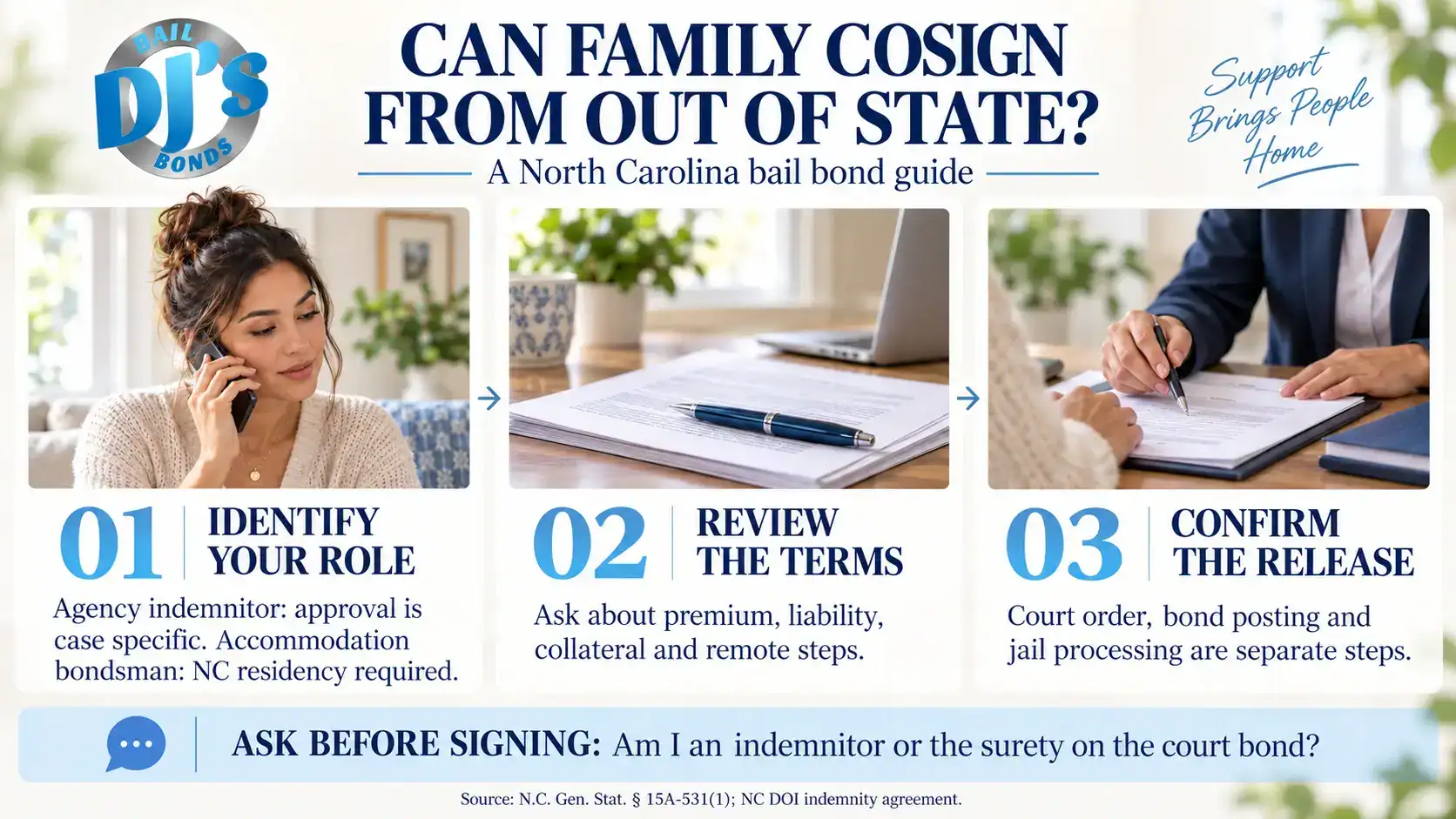
An out-of-state family member may be considered as an indemnitor under a licensed bond agency’s agreement if the agency approves the application and the court order permits the proposed surety bond. That is one way a family member might cosign a North Carolina bail bond from elsewhere. An accommodation bondsman who personally signs the court bond as surety is a different role; North Carolina law requires that person to be a bona fide state resident. Ask which role applies before paying or signing.
This guide is for someone living outside North Carolina who wants to help a person held in North Carolina. It covers what to verify about the release order, the agency agreement, money, and the steps that may be handled from another state. The actual court order and the agreement offered for the particular bond control the outcome.
Jump to the answers
Which role would I take? · Can I start remotely? · What must the court permit? · What could I owe? · Frequently asked questions
First, find out what “cosign” means
Families often use cosigner for several different jobs. If you plan to cosign a North Carolina bail bond from out of state, the distinction matters before you agree to any document.
01 Indemnitor under an agency agreement
You sign an agreement with the bondsman and accept the financial duties in that document. Ask whether the agency will consider your out-of-state address and what identification, signatures, payment, or collateral it needs. Approval is case specific.
02 Accommodation bondsman
This person personally signs the court’s appearance bond as surety without receiving a fee for doing so. North Carolina defines an accommodation bondsman as a person at least 18 years old and a bona fide North Carolina resident, among other requirements. An out-of-state resident should not assume they qualify for this role.
03 Professional or insurance-backed surety
A licensed professional bondsman or insurance company may be the surety on the court bond. A family member may separately sign an indemnity agreement with the agency. Signing that agreement does not make the family member a licensed bondsman.
The legal definitions appear in N.C. Gen. Stat. § 15A-531. The North Carolina appearance-bond form identifies the types of court bond signer, while the Department of Insurance’s sample indemnity agreement identifies the indemnitor and the bondsman as separate parties.
The question to ask: “Am I signing the court bond as an accommodation surety, or an indemnity agreement with the licensed bondsman?” Get a clear answer before accepting any signature link.
Can you begin from another state?
Potentially, yes. If you want to cosign a North Carolina bail bond, DJ’s has online forms, including an indemnitor application, and its online bail bond guide explains how someone outside Raleigh can begin supplying information. Starting an application does not mean the agency has approved you, accepted your signature, posted a bond, or established that the defendant can be released.
The agency may need to verify your identity, review finances, discuss collateral, obtain a particular signature, or arrange another transaction-specific step. Ask which parts can be handled by phone or through its secure process for this bond. An electronic form does not establish that every remaining step can be completed remotely.
You can start the conversation before you know the bond amount. Have the defendant’s full legal name, date of birth, county, and facility ready if known. Ask the agent what else must be verified against the detention facility’s records and the court’s order.
Check the release order before discussing payment
Your willingness to cosign a North Carolina bail bond cannot create one. A judicial official determines release conditions under N.C. Gen. Stat. § 15A-534. If a payable bond has not been authorized, or another hold prevents release, an agency agreement cannot override that restriction.
- Is a bond set on every relevant charge? One amount shown for one case may not describe all pending matters.
- Does the current order permit the proposed surety bond? Ask the agency to review the actual terms and additional conditions.
- Is there another hold? The jail or an attorney can help clarify custody issues beyond the bond being considered.
- Which county and facility handle the transaction? Your home state does not determine where the defendant’s North Carolina bond is posted.
What might the agency ask an out-of-state indemnitor?
There is no universal approval checklist for every bond. An agency may review your identity, relationship to the defendant, contact information, ability to meet the agreement’s financial terms, and the particular bond. Ask DJ’s what it needs and use a verified, secure channel for sensitive information.
Information to have ready for the first call
- About the defendant: full legal name, date of birth, county or jail, booking number if known, and bond amount if available.
- About you: legal name, current state and address, phone number, relationship, and identification through an approved process.
- About the bond: any other holds, permitted security, and whether an indemnitor or collateral may be needed.
- About logistics: whether your application can be reviewed remotely and whether any step needs someone to appear in person.
DJ’s separate guide to bail bonds without a cosigner discusses when a cosigner may be required. This article addresses the residency, paperwork, and agreement questions that arise when the person helping lives in another state.
Know what you could owe before signing
If you cosign a North Carolina bail bond, understand the money before accepting any terms. The court’s bond amount and the agency’s premium are different. North Carolina law says a licensed bondsman’s premium may not exceed 15% of the bond’s face amount. The law also allows collateral security or indemnity that is reasonable in relation to the bond amount. See N.C. Gen. Stat. § 58-71-95(5).
Example, not a price quote
A $10,000 bond has a statutory maximum premium of $1,500 under a 15% cap.
This example does not state DJ’s price for any bond. A payment-plan installment may cover only part of the total premium. Request the total premium, amount due now, remaining balance, due dates, and any separate collateral terms in writing.
An indemnity agreement can also create an obligation if the bond is forfeited. The North Carolina Department of Insurance’s sample agreement illustrates a guaranty connected with forfeiture. Your obligations depend on the actual document you sign, the bond, and applicable law. Do not treat an indemnitor signature as “just paperwork.”
Five questions to get answered in writing
- What is my role? Indemnitor, premium payer, collateral provider, or a combination?
- What is the full cost? Total premium, payment schedule, and any other permitted terms?
- What if the defendant misses court? Show me the relevant forfeiture and indemnity clauses.
- Am I pledging collateral? What property, how is it documented, and when must it be returned?
- Where are my copies? Keep the signed agreement, receipts, and the agent’s contact details.
Under § 58-71-95(5), collateral required by a bondsman must be reasonable relative to the bond amount and returnable collateral must be returned within 15 days after final termination of liability. That date is not necessarily the day the defendant leaves jail. Ask how you will learn when liability ends.
A remote application does not guarantee a remote release
Separate these three decisions when you ask for updates:
A person may finish paperwork from another state while the defendant remains in custody because of another hold, an additional bond, an uncompleted booking step, or facility processing. Ask the agent when the bond was actually posted; ask the facility about physical release. Neither an electronic signature nor an agency estimate guarantees a departure time.
Example: a parent in Virginia, a defendant in Wake County
Suppose a parent in Virginia learns that an adult child is held in Wake County. The parent asks whether they can cosign a North Carolina bail bond, but does not know whether the court order permits a surety bond.
The parent confirms the child’s legal name and custody location, then calls DJ’s at 919-986-1547. The agent reviews the available bond information and explains whether an indemnitor application can be considered. The parent asks which steps can be completed remotely and requests the written premium and indemnity terms. If the bond is permitted and the agency approves the transaction, the required signing and posting steps can proceed. The detention facility still controls release processing.
If the parent instead intends to personally sign the court bond as an accommodation bondsman, North Carolina’s residency requirement presents a separate issue. These roles are not interchangeable. This example illustrates the questions to ask; it promises neither approval nor a particular release time.
When should you speak with a lawyer?
Contact a North Carolina criminal defense attorney if the release order is unclear, release has been denied, another hold needs legal review, or the defendant wants to ask a court to change the conditions. A bondsman can explain the bond transaction and agency agreement, but does not represent the defendant in the criminal case or decide what conditions the court will authorize.
Consider independent legal advice before accepting an indemnity obligation you do not understand. If you are unsure whether to cosign a North Carolina bail bond, ask for the proposed agreement and have an attorney review the obligations. Get a complete copy of what you sign and confirm where notices will be sent, especially when you live outside the state.
Frequently asked questions
Can I cosign a North Carolina bail bond if I live in another state?
You may be considered as an indemnitor under a licensed agency’s agreement if the agency accepts your application and the court order permits the proposed bond. An accommodation bondsman who personally signs the court bond is a different role and must be a bona fide North Carolina resident. Ask which role you would take.
Do I need to travel to North Carolina to start?
Not necessarily. Someone hoping to cosign a North Carolina bail bond can begin providing information through DJ’s online forms from outside Raleigh. Whether signatures, verification, collateral, payment, or other steps can be handled remotely depends on the specific bond. Confirm the process before making travel plans.
Does signing an indemnity agreement make me a bail bondsman?
No. An indemnitor who signs an agreement with a licensed bondsman does not thereby become a licensed bondsman or the accommodation surety on the court bond. Read the document heading, signature blocks, and obligations.
Can I pay the premium without signing as an indemnitor?
Paying the premium and accepting indemnity obligations are different acts. Whether an agency accepts payment without requiring an indemnity signature depends on the proposed bond and the agency’s approval. Ask for the arrangement in writing before paying.
Can an out-of-state cosigner replace a “no bond” order?
No. A cosigner cannot set a bond, change a judicial release order, or remove another hold. Confirm custody and release conditions with the appropriate facility, and speak with an attorney if legal review is needed.
Can I send a photo of my ID to start?
Ask the agency which secure channel it uses and whether identification is needed for your application. Verify the recipient through the company’s published phone number. Avoid sending identification, card details, or sensitive documents to an unverified contact.
What if the defendant misses court?
Missing court can lead to an order for arrest and bond-forfeiture proceedings. Your potential obligation depends on the bond and your actual indemnity agreement. Contact the bondsman promptly about the agreement; the defendant should seek advice from a criminal defense attorney about the case.
Will the defendant be released as soon as I sign electronically?
No. An application is separate from the court’s release order, agency approval, posting of the bond, and final detention-facility processing. Confirm the status of each step instead of relying on a promised release time.
Your next call
Get the right role and terms in writing
If you live outside North Carolina and want to cosign a North Carolina bail bond for someone held in a county DJ’s serves, call DJ’s Bail Bonds at 919-986-1547. Have the defendant’s name, date of birth, and custody location if known. Say that you live out of state and ask whether you are being considered as an indemnitor.
You can also begin with the secure forms. Before paying or signing, confirm the court order, your precise role, and the complete agreement.
Official sources
- N.C. Gen. Stat. § 15A-531: definitions of accommodation bondsman and surety.
- N.C. Gen. Stat. § 15A-534: judicial release conditions.
- N.C. Gen. Stat. § 58-71-95: premium limit and collateral rules.
- NC Department of Insurance indemnity agreement and North Carolina appearance-bond form: examples of the separate documents and roles.
This article provides general information, not legal advice. Check the current law, the controlling release order, and the actual agency agreement for the particular case. DJ’s Bail Bonds cannot decide release conditions or guarantee approval or a release time.