

NORTH CAROLINA RELEASE GUIDE
Can someone go home before the first court appearance?
A family guide to the magistrate, the release order, judge-only decisions, and the next move
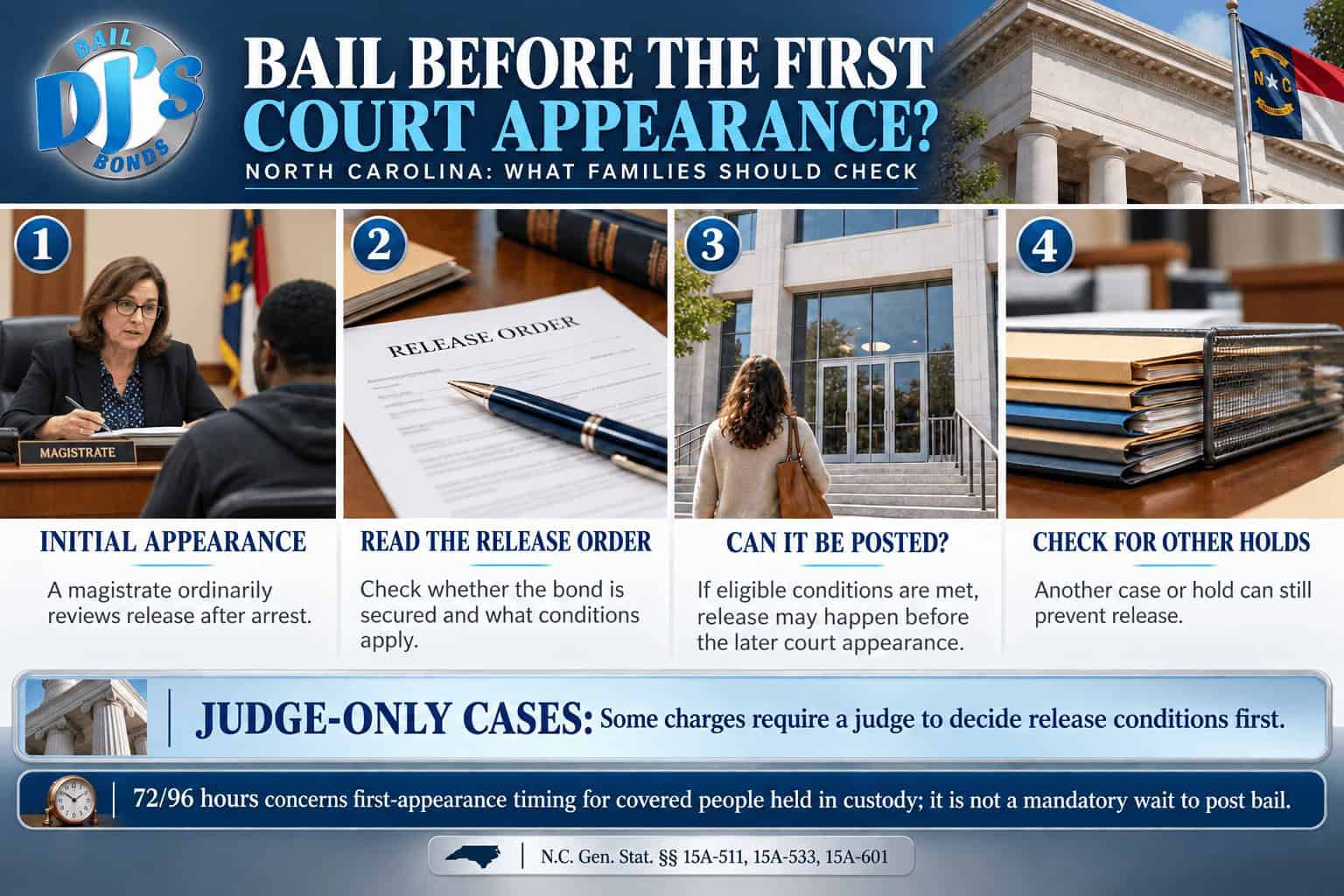
Quick answer: Bail before first court appearance in North Carolina is possible in many cases. A person may be released before appearing before a district court judge. After an arrest, the person ordinarily has an initial appearance before a magistrate. If the judicial official sets conditions of pretrial release that the person can meet, release may happen before the later first appearance in district court. Some charges require a judge to make the release decision, and a separate hold or unmet condition can prevent release. The court’s written conditions—not an estimate from an arrest record—control what can be done. N.C. Gen. Stat. §§ 15A-511, 15A-601 · § 15A-601
Bail before first court appearance is a common question because the phrase “first appearance” causes real confusion. A loved one calls from jail and says a hearing is in two days. Someone else says the bond has already been set. Both statements can be true. The person may have seen a magistrate shortly after arrest and have a separate first appearance scheduled before a district court judge. Understanding which event has happened tells you whether a bond can be posted now, whether a judge must act first, and which questions to ask the jail.
This guide follows the decision points in that order. It does not assume that a displayed dollar amount guarantees immediate release, or that everyone must wait until court opens. North Carolina law makes the answer depend on the charge, the current release order, and any other reason the person is being held.
Start here: Ask whether a judicial official has issued a current Conditions of Release and Release Order. Find out who set the conditions, whether they include a secured bond, and whether any other hold or judge-only review remains. North Carolina Judicial Branch release-order form
Initial appearance vs. first court appearance: the difference that changes your timing
Initial appearance is the post-arrest appearance typically conducted by a magistrate. North Carolina law directs an arresting officer to take an arrested person before a magistrate without unnecessary delay. The magistrate informs the person of the charges, the right to communicate with counsel and friends, and the general circumstances of release. For a warrantless arrest, the magistrate also makes the required probable-cause determination. The magistrate then addresses release under the bail statutes or commits the person pending further proceedings. A judge or clerk may also conduct an initial appearance under the statute. N.C. Gen. Stat. § 15A-511
First appearance before a district court judge is a distinct step. Section 15A-601 covers a person charged with an offense in the superior court’s original jurisdiction and a person charged with a misdemeanor who is held in custody. The statute expressly contemplates that someone can be released before that first appearance. Where release occurs first, the statute directs that the first appearance be held at the next district court session in the county, subject to its stated exceptions. A judge who conducts the initial appearance may combine the proceedings. N.C. Gen. Stat. § 15A-601(a)–(c)
That is the core answer on bail before first court appearance: Often yes, if valid release conditions have been set and can be satisfied. A future court date by itself does not mean a family has to wait for that date. Likewise, seeing “bond” online is only the beginning of the inquiry; you must confirm the current order and whether the person is otherwise eligible to leave custody.
| If you hear… | Ask this next | Why it matters |
|---|---|---|
| “They have not been to court yet.” | “Have they had their initial appearance before a magistrate?” | A magistrate’s appearance and a judge’s later first appearance are different events. |
| “Bond is $____.” | “Is that the current signed release condition, and is it secured?” | The number alone does not establish how the condition can be met. |
| “They have to see a judge.” | “Is this a judge-only release decision, or the later first court appearance?” | Some cases require a judge to decide release; others already have conditions set. |
| “The bond has been posted.” | “Is there any other hold or unmet release condition?” | Posting on one matter may not resolve another obstacle to release. |
How bail before first court appearance works in North Carolina
1. Confirm where the person is and which charges are active
Get the person’s full legal name, date of birth if available, county of arrest, and booking location. If several counties or cases are involved, ask about each active matter. An online inmate listing can help you locate someone, but it may lag behind the latest order or leave out an unrelated hold. DJ’s guide to what to do after an arrest can help with the first steps; for the release decision, confirm details with the facility or a qualified professional handling the case.
Make a simple record: booking number if available, charge description, case number, court date, and the name of the county detention facility. Avoid sending sensitive identifiers to strangers who contact you about the arrest. A person calling you first and claiming to be the court or a bondsman is not proof of identity.
2. Find out whether an initial appearance has happened
Before the initial appearance, there may be no current conditions of pretrial release to satisfy. Ask the facility whether a judicial official has reviewed the case and whether an order is available. If someone says “no bond yet,” do not assume the person has been permanently denied release: the initial decision may still be pending, or the charge may require a judge rather than an ordinary magistrate decision.
For a warrantless arrest, the initial appearance includes a probable-cause decision. If the magistrate finds no probable cause, the statute calls for release. Where the process continues, the judicial official addresses bail or custody. These steps are legal determinations made by the court, not by a bail bond company. N.C. Gen. Stat. § 15A-511(c)–(e)
3. Read the type of release condition, not just the amount
North Carolina recognizes different pretrial release arrangements, including release without a commercial surety and secured appearance bonds. A family should identify which condition the judicial official actually imposed. An unsecured appearance bond generally does not require paying its face amount upfront; it is still a binding obligation with serious consequences if the defendant fails to appear. A secured bond requires an accepted form of security. A professional bail bondsman may be relevant when the order allows a qualifying surety bond. The release order controls the available route. N.C. Gen. Stat. art. 26, including §§ 15A-531, 15A-534
If the amount is $10,000, do not assume you have to hand a bondsman $10,000 or that a quoted service charge will be refunded after court. Ask separately for the court-set bond amount, the bondsman’s fee, any collateral requirement, the terms of any payment arrangement, and the amount that could become due if the agreement is breached. Ask for a written agreement before paying.
4. Check whether the release decision belongs to a judge
Some cases cannot follow the ordinary “magistrate sets conditions, then post” path. North Carolina’s domestic-violence release statute requires a judge to determine conditions for the covered charges and circumstances. If a judge has not acted within 48 hours from arrest, the statute directs the magistrate to act under its provisions. This is a rule about who determines release and when; it is not a promise that the person will be released at the 48-hour mark. N.C. Gen. Stat. § 15A-534.1
The statutes also reserve particular release decisions for judges in listed serious-offense cases. Under § 15A-533(b), a judge determines whether release is warranted for the specified offenses, and the statute provides a rebuttable presumption against release under ordinary conditions for those charges. A separate rule applies when a person is arrested for an allegedly new offense while already on pretrial release in another pending proceeding, with limited motor-vehicle exceptions and a 48-hour fallback in the statute. If a jail says “judge only,” ask which charge or statute requires the judge rather than guessing from the charge label. N.C. Gen. Stat. § 15A-533
5. Identify any separate reason custody continues
Even if a bond can be posted for the charge you are discussing, another matter may keep the person in custody. Ask whether there are other pending charges with separate release conditions, a warrant from another court, a probation matter, a hold from another jurisdiction, or an administrative or medical release step. The jail or the responsible authority must tell you what applies in the actual case. A bondsman cannot remove a court hold or authorize release contrary to a judge’s order.
When several charges are listed, ask for the conditions on each case, not just a “total bond” repeated over the phone. Different judicial officials may have entered different orders, and one case may have no secured amount available to post yet. Keeping the cases separate prevents a family from paying on the wrong assumption.
6. Arrange the permitted form of bond and follow through on the release
If a current order permits a secured surety bond, provide the bond company with the correct name, facility, county, case or booking number, charge information, and court-set amount. Ask who must sign, what fee and collateral apply, and what happens if the case has another hold. DJ’s Bail Bonds lists 24/7 contact at (919) 986-1547 for help evaluating whether its service fits the actual release order.
Completion of bond paperwork does not mean the person is instantly walking out. The detention facility still has to verify the paperwork and complete its release process, and an additional hold may remain. Ask the facility for an updated status instead of treating an estimated release hour as a guarantee. Once the person is out, keep the release order, bond paperwork, receipts, next court date, and any separate conditions together.
When must the first district court appearance happen?
For a covered defendant who remains in custody, § 15A-601(c) generally requires the district court first appearance within 72 hours after being taken into custody or at the first regular session of district court in the county, whichever comes first. If the courthouse is closed for transactions for more than 72 hours, the statute uses 96 hours or the first regular session, whichever comes first.
It has exceptions, including when the defendant has already been released under the bail article, and it directs the next district court session for a person released before the first appearance. The statute also provides for a clerk or, if unavailable, a magistrate to conduct a first appearance in specified judge-unavailability circumstances. N.C. Gen. Stat. § 15A-601(c), (e)
For bail before first court appearance, those 72- and 96-hour numbers are court-appearance rules, not universal waiting periods for bail and not guaranteed release deadlines. The separate 48-hour rules for covered domestic-violence charges and certain new-offense-on-release situations concern judge-only release determinations and their statutory fallbacks. If you are told to “wait 48 hours” or “wait 72 hours,” ask exactly which legal step is pending. That one question often clears up the most expensive misunderstanding in the process.
A person released before the judge’s first appearance still must follow the release order and appear as required. Release is permission to remain out of custody under conditions, not a dismissal of the charge. Ask the defendant’s lawyer about any disputed condition, alleged violation, or requested change. A bondsman can explain the bond agreement; a lawyer can advise about the criminal case.
Can a bondsman help before a judge sets bond?
A bondsman can help you prepare and can explain what information is needed, but cannot choose the court’s release conditions or override a judicial official. If the case has no current bond amount because a judge must decide release, signing a commercial bond agreement does not substitute for that decision. A good call at that stage is about identifying the order, confirming who can set conditions, and being ready if a secured surety bond is authorized.
If the current order provides an unsecured form of release or another condition that does not call for a commercial surety, ask what the facility requires to process it. You should not buy a product simply because someone says the person is “on bond.” The legal term bond includes arrangements other than a paid commercial bail bond. N.C. Gen. Stat. § 15A-531(4)
A legitimate consultation should make the cost and responsibility understandable: what fee is earned, whether collateral is required, who signs as indemnitor, which court appearances must be attended, and how the agreement handles a missed court date. Keep a copy of every document you sign. If you are considering a payment plan, ask for the complete payment schedule in writing before committing.
Three realistic scenarios
Scenario A: A magistrate has set a secured bond. A person is arrested on a charge for which the magistrate may determine release conditions. The release order allows a secured surety bond. Assuming no other hold and the bond is accepted, the person may be released before the later district court first appearance. The next step is to verify the order and arrange an accepted form of security, then confirm the court date.
Scenario B: The matter requires a judge to determine release. A person is held on a charge covered by a judge-only statute. A family sees an old or incomplete number online and offers to pay it. That number does not replace the judge’s decision. The next step is to find out when and by whom release conditions will be determined and consult defense counsel if needed. A bond company can discuss options after an eligible condition is set.
Scenario C: One bond is posted, but the person stays in jail. The paperwork is accepted on one case; a separate warrant or hold remains. The payment has not necessarily failed, and there is no general promise that posting one bond resolves every matter. The next step is to ask the detention facility which specific matter prevents release and contact the court or lawyer handling that matter.
These examples explain the workflow, not the outcome of any individual case. The release order and the actual custody record decide what happens next.
The five-minute call checklist for a family
Keep this list open when calling the detention facility or a bond company:
- 01 Identity: What full name and booking or case number identify the person?
- 02 Initial decision: Has an initial appearance occurred? Who entered the current release order?
- 03 Each case: Which charges or cases have separate release conditions?
- 04 Exact condition: Is it a written promise, an unsecured bond, a secured bond, or another condition? If secured, what forms of security are accepted?
- 05 Judge requirement: Does a statute require a judge to decide release on any charge? Has the judge acted?
- 06 Other holds: Is anything besides the bond preventing release?
- 07 Cost: If using a bail bondsman, what are the fee, collateral, signatures, payment terms, and possible obligations under the agreement?
- 08 After release: What court date, reporting instruction, no-contact rule, or other written condition must the defendant follow?
Families considering bail before first court appearance can call early without paying early. Confirm the court’s actual order before agreeing to a fee or surrendering collateral. If the answers conflict, ask for the case number and a copy or accurate reading of the latest conditions; release conditions can change as the case moves through court.
What changes after the person goes home?
The defendant must comply with every current release condition and attend all required court appearances. If an appearance date seems missing, do not guess: check the court notice or ask the clerk or defense lawyer. Keep phone numbers current and give the bondsman any updates required by the agreement. If the order restricts contact or travel, the person should read the exact language and ask counsel before taking an action that could violate it.
Families often focus on the first night and forget the months after release. A cosigner may have ongoing obligations under a private agreement; a person who provides collateral should understand how its return is documented when the bond obligation ends. DJ’s has a separate resource on North Carolina cosigner responsibilities and its collateral-return guide. The immediate priority here is simpler: know the next court date and preserve every signed document.
Need help understanding a current secured bond?
DJ’s Bail Bonds can review the information you have and explain its bond process. Call (919) 986-1547. Have the county, detention facility, defendant’s full name, current release condition, and any known holds ready. If release has not been authorized or you need advice about the charge, speak with a North Carolina criminal defense lawyer.
Frequently asked questions
1. Can you arrange bail before first court appearance in North Carolina?
Often, yes. The initial appearance before a magistrate can result in release conditions before the later first appearance in district court. If the person can meet those conditions and there is no other barrier, release can happen first. Judge-only cases or unresolved holds may change the timing. §§ 15A-511, 15A-601
2. Is an initial appearance the same as a first appearance before a judge?
No. An initial appearance is the early post-arrest proceeding ordinarily conducted by a magistrate. The district court first appearance is a separate proceeding under § 15A-601, although a judge who handles the initial appearance may consolidate them. Ask which proceeding has taken place. §§ 15A-511, 15A-601
3. Do you have to wait 72 hours to post bail?
No general 72-hour bail waiting period follows from the first-appearance rule. Section 15A-601(c) specifies when a covered person held in custody must receive a district court first appearance, with its exceptions. If valid release conditions can be met earlier, the statute accounts for release before that proceeding. § 15A-601(c)
4. Who sets the bond after an arrest?
A judicial official determines conditions of pretrial release under the applicable law. The magistrate ordinarily addresses release at the initial appearance, but certain charges or circumstances require a judge’s decision. The arresting officer, jail staff, and bail bond company do not set the court’s conditions. §§ 15A-511, 15A-533, 15A-534.1
5. Can a bondsman post a bond before a judge sees the case?
If an authorized judicial official has already entered an eligible secured surety bond and the facility accepts the paperwork, that may be possible. If the law requires a judge to decide release and no qualifying order exists yet, a bondsman cannot create one. Ask for the current release order first. §§ 15A-511, 15A-531
6. Why does the jail say “no bond” if a court date is scheduled?
A judge may still need to make the release decision, the order may not provide a payable secured amount, or the person may be held on another matter. “No bond” does not identify which of those applies. Ask what current order or hold is controlling custody and whether a judge has yet made a required determination.
7. Does a domestic-violence charge always mean exactly 48 hours in jail?
No. For charges covered by § 15A-534.1, the judge generally determines the conditions; if the judge has not acted within 48 hours of arrest, the magistrate must act under that section. It is a limit on waiting for the determination, not a fixed sentence of detention or a guarantee of release. § 15A-534.1(b)
8. What if the person was arrested while already out on another bond?
That can trigger a judge-only determination for the new alleged offense under § 15A-533(h), subject to the statute’s motor-vehicle exceptions and 48-hour fallback. The first bond and the new case also need to be checked separately. A lawyer can address how the new arrest affects pending conditions. § 15A-533(h)
9. Can someone be released on an unsecured bond without paying a bondsman?
Potentially, if the current order provides an unsecured appearance bond and the person meets all conditions. “Unsecured” does not erase the obligation to appear or comply with the order. Check the actual written conditions and ask the facility what is needed for release. §§ 15A-531, 15A-534
10. Will posting the bond guarantee immediate release?
No. The facility must process and accept the bond, and another case, warrant, or hold may still prevent release. Confirm whether the posted bond satisfies all current release conditions and ask the detention facility what remains pending. Avoid planning around an exact release hour unless the facility confirms it.
11. What should I ask before paying a bail bond fee?
Verify the current court-set amount and accepted bond type. Then ask for the written fee, any collateral, who is signing, the payment schedule, what happens if the defendant misses court, and how collateral return will work. Ask whether another hold could prevent release despite the bond being posted.
12. Does release before first appearance mean the case is over?
No. Pretrial release lets a person remain out of custody while the case continues, subject to court-ordered conditions. A first appearance or other court date may still be required. Keep the release order and notices, follow every condition, and obtain legal advice about the criminal charge. § 15A-601