

North Carolina bail guide
Originally published: September 7, 2026. Release decisions depend on the current court order and the facts of the case. This guide explains the process; it cannot determine whether a particular person is eligible for release.
If a jail record says “no bond,” it is natural to ask whether you can pay something to bring your loved one home. The immediate answer is no: there is no amount a family or bail bondsman can post while a controlling order does not authorize release on a bond. The useful next step is finding out why that status appears.
Sometimes release conditions are still waiting for a judge. In other cases, a judicial official has decided that the defendant should remain in custody. A person may also have a separate hold that prevents release even though another charge shows a bond amount. Those situations have different next steps, so the short label in an online record should never be treated as the complete court order.
Quick Answer: What Does “No Bond” Mean in North Carolina?
“No bond” generally means there is currently no payable bond that will secure the defendant’s release from custody. It does not, by itself, tell a family whether the status is temporary, whether a judge has denied release, or whether another case or hold is involved. Confirm the current order and every reason the person is being held before discussing payment.
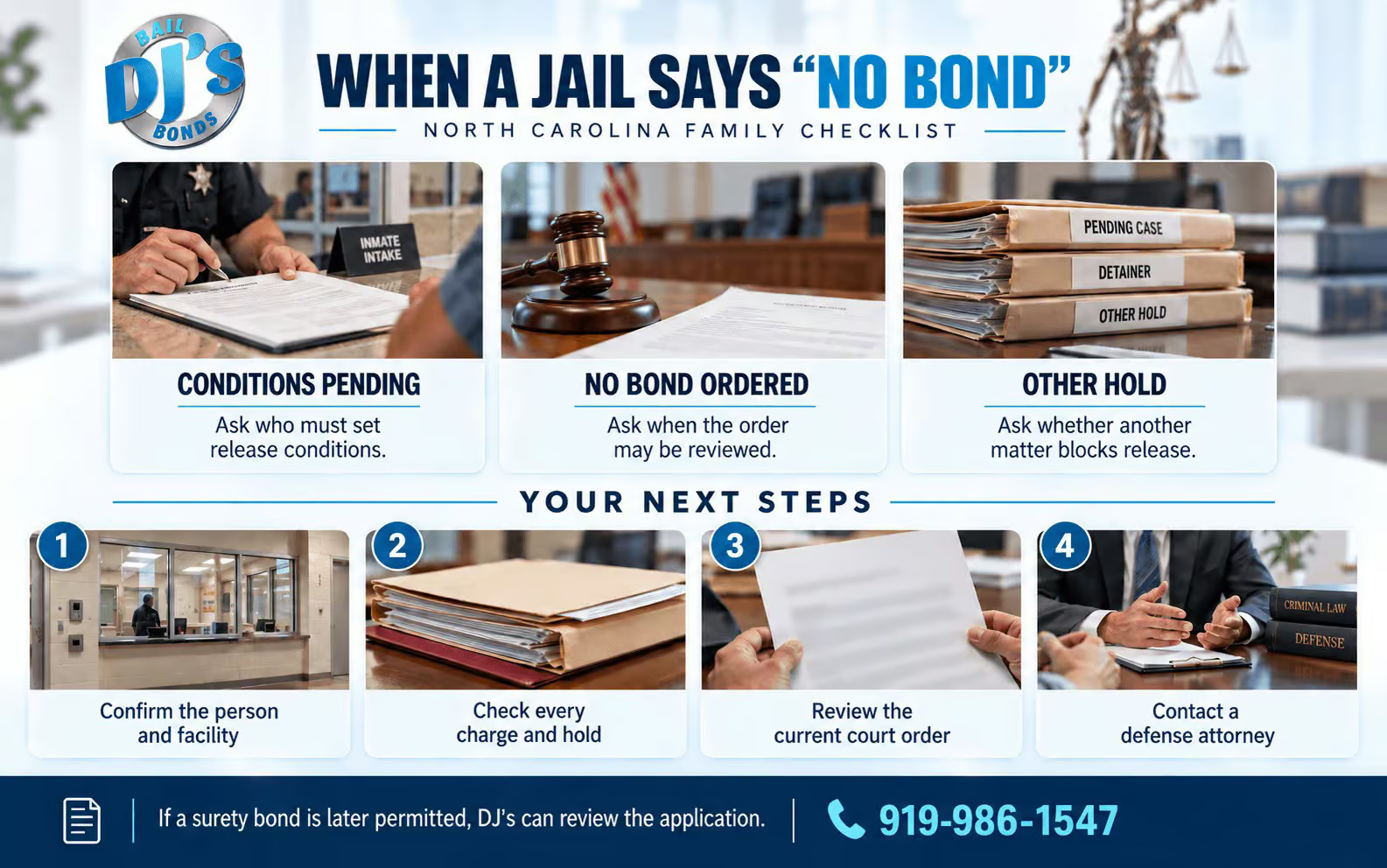
Ask the detention facility or the defendant’s attorney three direct questions: Have release conditions been set for every charge? Is a judge required to make or review the decision? Is there another hold that would prevent release even if a bond were posted? A licensed bail bondsman can explain an eligible surety bond if the court later permits one. A bondsman cannot create a bond amount, overturn a court order, remove a hold, or guarantee release.
“No Bond,” “Bond Not Set,” and “Bond Set” Are Different
Families often see a brief status in a jail search result without seeing the underlying paperwork. Confirm what the entry means before paying anyone or starting an application. These descriptions are a guide to the questions to ask, not a reading of a particular person’s order.
| Status | What it may mean | What to ask |
|---|---|---|
| Bond not yet set | A release decision is pending, or the available record has not been updated. | Who must set the conditions, and when is the next proceeding? |
| No bond ordered | No payable bond is available under the controlling order at this time. | Which order controls, and when may it be reviewed? |
| Secured bond set | Release may be possible once the ordered security and other conditions are satisfied. | Does the order permit a surety, and are there other holds? |
| Unsecured bond or other condition | A commercial bail bond may not be needed, but the court’s conditions still apply. | What must happen before the facility can release the person? |
| Bond on one charge; hold on another | Posting the visible bond may not lead to physical release. | Have all charges, cases, warrants, and holds been checked? |
The North Carolina Judicial Branch’s criminal cases guide explains the general stages of a case and notes that bond may be reviewed at a court hearing. A current release order, rather than a summary label, determines what can actually be done.
Consider two examples. One family calls shortly after an arrest and learns that a judge has not yet entered the required release conditions. Their useful next step is to confirm the upcoming proceeding and speak with counsel; there is no bond amount to pay yet. Another family sees a secured bond on one charge but learns that a separate matter keeps the person in custody. They need the attorney and facility to clarify that other matter before deciding whether posting the visible bond makes sense. In both examples, an online status alone leaves out the fact that changes the family’s decision. These examples illustrate questions to ask; they do not predict how an individual case will be handled.
Who Decides Whether Someone Can Be Released?
A judicial official, not a bail bond company, determines pretrial-release conditions. North Carolina law generally requires a person who has been arrested to be taken before a magistrate without unnecessary delay for an initial appearance. The magistrate informs the person of the charges, the right to communicate with counsel and friends, and the general circumstances under which release may be available. Certain cases require a judge to determine release conditions. See N.C. Gen. Stat. § 15A-511.
A release order can involve an unsecured bond, a secured bond, release to the custody of a supervising person or organization, house arrest with electronic monitoring where authorized, and restrictions on travel, conduct, associations, or residence. A dollar amount alone does not describe every release condition. The governing rules are in N.C. Gen. Stat. § 15A-534.
This distinction matters when someone offers to “get a bond set” for a fee. A bondsman can evaluate and post an eligible surety bond after the appropriate order exists. Only an authorized judicial official can make or change the release decision. The detention facility then handles final physical release.
Why Might a North Carolina Jail Show “No Bond”?
There is no single statewide explanation for every “no bond” listing. These are the possibilities to check with the facility and, when the answer involves legal interpretation, the defendant’s attorney.
A judge must determine the release conditions
For certain charges or circumstances, a magistrate may not be the official who makes the initial decision. North Carolina has special judge-led procedures for specified domestic-violence cases and for a new offense allegedly committed while a defendant was on pretrial release in another pending case. Waiting for the appropriate official’s decision should not automatically be described as a permanent denial of release. See § 15A-534.1 and § 15A-533(h).
A judicial official has not authorized release
Some charges and circumstances carry stricter pretrial-release rules. North Carolina law gives a judge discretion over release for certain serious offenses and creates a rebuttable presumption against release in specified situations. “Rebuttable” does not mean release is guaranteed; the applicable rule and the facts must be considered. The charge, prior history, governing statute, and actual court findings matter. See § 15A-533.
Another case or hold affects custody
A person can have more than one charge or legal matter. Even if a family sees a bond amount for one case, a separate order or hold may prevent release. Ask the facility whether every basis for custody has been identified. Do not assume that paying the amount displayed beside one charge resolves the others.
The public record is incomplete or behind
A public search result may not show the full release order or the latest court action. Confirm an unclear status through the detention facility, the attorney, or the clerk’s office for the county handling the case. DJ’s has a separate guide to finding someone in jail in North Carolina; that guide helps locate the person, while this article explains what to ask after a “no bond” status appears.
Did North Carolina’s 2025 Bail Changes Make Every Serious Charge “No Bond”?
No. The law must be applied to the specific charge and defendant. Changes effective in December 2025 defined “violent offense” for the bail statutes and established a rebuttable presumption that no release condition will reasonably assure court appearance and community safety for a defendant charged with such an offense. The statute also addresses which conditions may apply if a judicial official determines release is appropriate. See § 15A-531(9) and § 15A-534(b1).
A relative cannot reliably predict the outcome from a broad label such as “felony,” “violent,” or “no bond.” An attorney can review the exact charges, applicable version of the law, court order, and appropriate method of seeking review. Publication-date note: The provisions discussed here were in effect by September 7, 2026. Check the current statutes and controlling order when an individual case arises; a later amendment may change the applicable rules.
What Should You Do First If a Loved One Has “No Bond”?
Start with facts that can be confirmed. You do not need to solve the legal issue during the first call.
1. Confirm the person and the custody location
Have the defendant’s full legal name, date of birth, and booking or case number if available. Confirm which county and facility currently hold the person. Someone arrested in one city may be processed at a county facility; a transfer may make an earlier location outdated. For local service information, see DJ’s pages for Wake County and Fayetteville and Cumberland County. Verify the actual facility before traveling.
2. Ask whether release conditions exist on every charge
Use a direct question: “Have conditions of pretrial release been entered for this person on every charge?” If the answer is no, ask who is expected to make the decision. If the answer is yes, ask what the current order says and whether another order affects custody. Record the facility, the time of the call, and the booking or case number. Those details help the attorney or agent follow up without relying on an outdated screen.
3. Find out whether another hold is involved
Ask: “If this charge receives a bond, is there any other hold that would still prevent release?” Facility staff may have limits on what they can disclose or interpret, but the question helps prevent an expensive misunderstanding. Confirm the answer again before making a payment connected with a bond.
4. Contact a criminal defense attorney when release is denied or unclear
An attorney can examine the orders and charges, explain available hearings or requests for review, and advise the defendant about the case. A bail bondsman does not represent the defendant in court or argue for a different release decision. If the family cannot hire counsel, ask the court or the defendant’s attorney about eligibility for appointed representation.
5. Speak with a licensed bondsman if a surety bond becomes available
Once the court permits a secured bond that can be satisfied by a surety, an agent can review whether that bond can be written and explain the application, premium, and any cosigner or collateral terms. Agency approval is separate from the court’s decision. After an approved bond is posted, the detention facility still controls its own release processing.
Can a Bail Bondsman Help Before a Bond Is Set?
A bondsman may help you understand what information will be needed later, but cannot post a bond that has not been authorized. You can call with the person’s name, date of birth, county, and facility even when the amount is unknown. Ask the agent to separate facts they have verified from information that is still pending.
Do not sign or pay based on a promise that a particular bond amount will appear. If the court eventually permits a surety bond, review the complete written agreement: total premium, amount due initially, payment schedule, cosigner duties, and any collateral requirement. DJ’s has a separate explanation of the difference between bail, bonds, and release on recognizance.
Can “No Bond” Change Later?
It can, depending on the reason and the governing order. A status may change after an authorized judicial official sets initial conditions or after a court reviews an existing release order. North Carolina law permits the appropriate judicial officials to modify pretrial-release orders at different stages of a case. A change is possible, not automatic. See § 15A-534(e)–(f).
An attorney is the right person to explain whether and how to seek review, what information the court may consider, and what restrictions might apply if release is allowed. Under § 15A-534(c), the decision can account for the alleged offense, criminal history, family ties, housing, financial resources, and past failures to appear, among other available information. Give the attorney accurate facts rather than assuming one favorable detail guarantees release.
Does a First Appearance Automatically Mean a Bond Will Be Set?
No. A first appearance is a court proceeding, not a promise that a payable bond will be ordered. The process and timing depend on the charge and whether the person remains in custody. N.C. Gen. Stat. § 15A-601 sets rules for first appearances before a district court judge.
There is an important difference between the initial appearance soon after arrest and a later first appearance before a district court judge. Families sometimes hear both called a “bond hearing,” although they serve different procedural roles. Ask the attorney or court which proceeding is scheduled and whether release conditions may be addressed there. A court decision, posting an eligible bond, and jail discharge are separate steps; none comes with a guaranteed release hour.
What If a Bond Amount Appears but the Person Is Still in Jail?
A displayed amount tells you only part of the story. Before assuming a bail bond will result in release, confirm the bond type; whether the order permits a surety; whether supervision, monitoring, or other conditions remain; whether another charge or hold is involved; whether the order has changed; and whether an approved bond has actually been posted. The facility still completes its own security and discharge procedures.
Before paying: Ask what has been verified, what remains uncertain, the complete written financial terms, and whether a separate hold could keep the person in custody. Posting one bond cannot erase a different legal restriction.
Does “No Bond” Mean the Person Has Been Found Guilty?
No. Pretrial custody and release decisions occur while a criminal case is pending. “No bond” describes the present release status; it is not a conviction or a finding of guilt. The charge, court orders, and the defendant’s rights must be addressed through the legal process.
This matters in practical terms. A family under pressure may mistake a “no bond” entry for a fine or a price to settle the case. It is neither. Confirm the court status, consult counsel when needed, and use only verified payment channels if a payable bond is later authorized.
A Practical Checklist for Families in Raleigh and Across North Carolina
Keep one short record that anyone helping the family can use. Write down who supplied each answer and when you received it, especially when a public record and a facility representative appear to disagree.
| Information to confirm | Why it matters |
|---|---|
| Full legal name and date of birth | Helps identify the correct person in custody. |
| Current jail and county | Identifies which facility and court to contact. |
| Booking and case numbers | Helps staff locate the correct records. |
| All charges and custody holds | A bond on one charge may not clear another matter. |
| Current release order and bond type | Determines whether a surety bond can be considered. |
| Next court proceeding | Tells counsel which decision or review may be approaching. |
| Verified agent and written terms, if a bond is permitted | Makes financial obligations clear before signing. |
For a Wake County arrest, the Wake County bail bonds page explains DJ’s local assistance. Families elsewhere can consult its North Carolina service areas or call to confirm availability. The court’s order and actual custody location determine the next step—not where the relative making the call lives.
Frequently Asked Questions
Can I pay to get someone out if the jail says “no bond”?
No payable bond is available while the controlling order does not authorize release on one. Paying a bail bond company cannot change a judicial decision. First confirm whether conditions have not yet been set, release has been denied, or another hold affects custody. If a secured bond that permits a surety is later authorized, a licensed bondsman can evaluate an application.
Is “no bond” the same as a $0 bond?
No. A “no bond” entry should not be read as permission to leave without paying. A court may authorize a form of release that does not require a commercial bail bond, but the person must still meet the actual conditions of the order. Ask the facility or attorney what the current order requires; an online label cannot replace that review.
How long can someone be held while waiting for a bond decision?
There is no single time limit that accurately describes every “no bond” situation. Different statutes address different circumstances, including specified cases in which a judge must determine release conditions. Timing also differs between an initial appearance, a district court first appearance, and later court review. Ask which statute or order applies to this case and contact an attorney promptly if the status is unclear.
Can a judge change a “no bond” order?
Depending on the case and its procedural stage, an authorized judge may review or modify pretrial-release conditions. A request is not guaranteed to succeed, and release may remain unavailable. The defendant’s attorney can examine the current order, identify the correct procedure, and explain the facts and legal rules that matter. A bail bondsman cannot act as the defendant’s legal counsel.
Does a domestic-violence arrest always mean there will be no bond?
No. North Carolina has special release procedures for specified domestic-violence-related charges, including a rule that a judge initially determines conditions in covered cases. The precise charge and order control the outcome. Do not assume every case has the same waiting period or release restriction. Review the actual order with an attorney; see § 15A-534.1.
What if the website shows a bond amount but the jail says there is a hold?
Confirm the current order and every reason the person remains in custody before arranging payment. A bond shown for one charge may not resolve another case, warrant, or hold. Ask the facility what it can confirm about release eligibility, then have the attorney review unresolved matters. A surety bond can address the obligation it covers; it cannot erase a separate restriction.
Should I contact a lawyer or a bail bondsman first?
If a release decision has been denied, has not yet been made, or needs to be challenged, contact a criminal defense attorney for legal advice. If the court has permitted a secured surety bond, a licensed bondsman can explain the application and written financial terms. You may contact both for their different roles, but preparing for a possible bond does not guarantee one will be set.
What information should I have when I call DJ’s Bail Bonds?
Start with the defendant’s full legal name and date of birth. The county, current facility, booking number, charges, and bond information are helpful when known. Say clearly if the record shows “no bond” or another hold has been mentioned. DJ’s can explain whether an eligible surety bond is currently available for review; the court controls conditions and the facility controls physical release.
Get a Clear Answer About the Next Step
If someone you care about is in custody, confirm the current release order before discussing payment. For legal advice about a “no bond” decision or changing release conditions, speak with a criminal defense attorney. If the court permits a surety bond, DJ’s Bail Bonds can review the available bond and explain its application and written terms. Call 919-986-1547 with the defendant’s name, date of birth, and county if known. DJ’s lists 24/7 assistance and a physical Raleigh office; call before visiting.
Official North Carolina Sources
- North Carolina Judicial Branch: Criminal Cases and Appearance Bonds
- N.C. Gen. Stat. § 15A-511: Initial Appearance
- N.C. Gen. Stat. § 15A-533: Right to Pretrial Release
- N.C. Gen. Stat. § 15A-534: Release Conditions and Review
- N.C. Gen. Stat. § 15A-534.1: Specified Domestic-Violence Cases
- N.C. Gen. Stat. § 15A-601: First Appearance Before a District Court Judge
Reviewed by DJ’s Bail Bonds staff. This informational guide describes the bail-bond process and cites official North Carolina resources. DJ’s Bail Bonds does not decide court release conditions or provide legal representation. For advice about a particular case, consult a licensed North Carolina criminal defense attorney.